Showing posts with label Pendragon. Show all posts

Friday, 2 September 2011

Death on the Lake: Pendragon Campaign year 486.

Sir Tywin of Stapleford,  played by Caroline
 Sir Godrick of Baverstock, played by Silv
Sir Galen of Woodford, played by Aimee
Sir Valiance of Steeple Langford, the spare.


While Earl Roderick and the majority of his knights will be riding with King Uther and Prince Madoc to hunt down the Saxons raiding near Colchester, the PC knights learn to their great disgust that they will remain behind to protect Salisbury. Nonetheless, come the summer they dutifully attend at Sarum where they once again find themselves placed under the command of the Marshal, Sir Elad. There, the news that Sir Leoric has been allowed to accompany the Earl, despite being one of the Marshal's own knights, only adds to their annoyance. The group had, it seems, been looking forward to the pagan knight's company as a means of alleviating their boredom on patrol. Splitting his forces into four, the Marshal assigned the player knights to patrol the southern border of the County. For several days they travelled from manor to manor, checking to ensure that the peasants were up to no mischief in the absence of their lords and that no noble lady grew too lonely or afraid in her husbands absence.

Yet in time, one misty morning, they came upon a strange sight indeed: an old greybeard, wrapped in goat-skins and carrying a worn crook, standing on the path at the base of a steep hill and calling out for someone called Bill. Immediately suspicious at finding such an old fellow out on his own in these dangerous times, the four knights approached warily, keeping an eye out for an ambush. It transpired then, that the old man was a goat-herd in search of his prize goat. Sneering, but expecting something of import afoot (perhaps even an ambush of some kind) Sir Tywin (currently the most glorious knight and, hence, the party leader) ordered Sir Valiance to remain behind while the others rode up the hill.

The knights soon heard the tinkling of a small bronze bell not far away, and caught flashes of something white furred and fleet through the trees. After kicking their mounts forward once the ground leveled out, they quickly came across the goat.

Hanging upside down

Bleating

It's tail clenched in the meaty, greasy fist of a huge, three-eyed giant.

Without hesitation, seeing the feast before him, the giant tossed the terrified goat over one shoulder, uprooted a small tree, and charged the three knights. Immediately Sir Galen and Sir Tywin charged to meet it, but Sir Godrick again held back long enough to throw a spear at the beast. Meanwhile, down below, Sir Valiance spurred his horse through the trees at the first sound of combat.

It was indeed a vicious battle, with blows from his mighty club the giant knocked first Sir Galen then Sir Godrick from their mounts, though on both occasions the knights managed to remount and continue the fight. Sir Tywin however, took a blow to the head from the giants club that left him senseless -and careering in  terror back down the hill (having failed his valour check for a major wound), passing the astonished Sir Valiance on the way- and pursued by his hideously embarrassed -nay, mortified, squire. Sir Valiance came upon the scene just as Sir Godrick finally hacked through the massive creature's tree trunk. Valiance seized his moment to charge - his finely aimed spear point lancing through the creatures heart. Exhausted, Sir Godrick and Sir Galen (both down to just a few hit points each) slid from their horses. While Sir Galen rested, Sir Godrick tried to claim the giant's head as a trophy. Non-plussed, Sir Valiance pointed out that the final blow -the kill- had been his. And that by the laws of the hunt, the prize was his also. Sir Godrick relented and settled for taking some lesser trophy. Meanwhile, as a chagrined Sir Tywin rode back into the clearing (having downed the healing draught thoughtfully provided by his fae young wife) Sir Galen paused to examine the well and truly dead goat, it's back having been broken in it's "fall".

Determined to obtain some answers, four bloddied knights and their squires rode back to the old man post haste. Seeing them arrive, the old man chuckled to himself and spun round, triumphantly casting aside his guise. Arms spread-eagled, the elderly fellow revealed himself for who -and what- he truly was: The wizard. Merlin.

"Merlin! What trickery is this?" demanded an irate Sir Valiance, the giants bloody head dripping down his horse's flanks. The old wizard chuckled. " You have passed the test," he smirked, "oh... that's good! That's it. Yes. You have passed the test and now must come with me -to save this land from ruin. No questions. Follow me!"

And with that, the mysterious wizard, in his tall, silver skull-cap and wielding a dark-wood staff topped by a silver dragon design, stalked off into the forest. Unnaturally fast, so that the mounted knight had to hurry after.Yet even as they passed under the eaves of the trees, so, they felt refreshed, as though they had rested for a day or more under their leafy shelter.

"But Merlin? What must we do?" Called Sir Tywin, at the head of the four knights, while a perfect lake of clear, calm water came into view beyond the treeline.

"Do nothing!" the old wizard called back over his shoulder, not slowing his pace. "Rest in the arms of the dragon. Ah! No scratch that! Too late! Aha!" Turning back to address the knights, Merlin flicked both eyebrows up briefly before announcing with a great degree of flamboyant showmanship. "We're here!"

"Where is here?" Sir Godrick asked, but the old wizard simply chuckled and stalked off into the waters of the lake. Turning, he addressed the knights, still walking backwards into the water. "I am in the service of your King. Uther. What I do is for him and for the land itself. Do not follow me and allow none to do so. This is the doom I set upon you." With that, he faced into the lake once more, the water lapping about him ever higher until, engulfed, even the silver of his skull-cap faded entirely from mortal sight.


"Bloody wizard," someone muttered (probably a squire), to the general agreement of all. Yet the four knights did not have long to wait. Soon, they heard a strange sound, similar (but not quite the same) as the noise of horse-hooves splashing through water. It was then that a strange knight rode into view, armoured all in fish-scale and riding upon a tall, shiny-coated horse with fins for feet and a fish-tail instead of hair. The knight paused beneath the trees a short distance away. In a strangely guttural voice (like a man speaking under water) the knight demanded:

"Let me pass!"

When the reply came from the four knights that they would not, the fish-knight did not hesitate. He lowered his spear and charged. Sir Galen, this time, was the first to give spur to horse and took a hefty  blow from the charging knight's spear on his shield. Sir Tywin and Sir Valiance quickly followed, yet the knight's incredible skill and fine armour saved him from all harm. Meanwhile, Sir Godrick's mis-thrown spear missed the knight entirely and instead struck Sir Tywin a glancing blow to the back of his head, though fortunately turned aside by his helm. Realising the folly of throwing into such a close melee, he too spurred into combat with the knight.
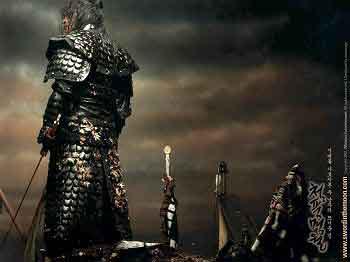
Unnaturally fast, the strange knight proved himself a more deadly a foe even than the giant. Within moments the fish knight inflicted numerous  wounds on all four Salisbury knights. In desperation, Sir Godrick struck at the knight's horse. Outraged, fish-knight flicked Godricks sword aside effortlessly and, in a righteous, display of passionate fury at such a dishonourable display from the young knight, clove Godrick near in twain with a single blow.

For a single, horrified moment, Sir Galen, Sir Tywin and Sir Valiance paused in their efforts while their friend slide from his steed to the ground below. At this point, all three players declared their character's intention to "go mental" (or words to that affect). With now seeming like a good time to determine the Loyalty (Group) Passion they had earned from standing over Sir Valiance's unconscious form for three hours in the midst of a battle last summer, I had the players roll 3D6 to determine their knights' passion scores. Sir Galen rolled a mere 8, Sir Tywin a tragic 3 but, (appropriately enough) Sir Valiance generated a Loyalty (group) Passion of 15.

Knowing that I would grant them all a +5 bonus to their passion due to seeing their friend hacked down before their eyes,  two of the three surviving knights (all except Sir Tywin) tried to call upon their passion. Yet Sir Galen failed miserably. The young knight fell into melancholy, caring little even for his own safety as he slid from his horse and rushed to cradle Sir Galen's head in his lap. Sir Twyin meanwhile continued his seemingly futile attacks. Attacks that repeatedly failed to slip past the knights defence.

However, Sir Valiance did, indeed, in the words of his squire, "get blood-drunk mad-with-it". Drawing himself up in the stirrups, the huge pagan knight threw away his shield and grabbed his sword in both hands, utterly forgetting the axe that hung by his side (far more useful against a foe with a shield) so great was his fury! For the next five rounds, Sir Valiance and the strange knight battered one another repeatedly, with the stranger criting at anything above 16 and Sir Valiance critting on anything above 11. Sir Tywin, feeling himself  somewhat ineffective in the face of this fury from friend and foe alike (and in danger of catching a blow or two himself from Valiance's back-swing), pulled his horse back into the trees to observe a martial display the likes of which he had never seen. Finally, with a great heaving roar that sent birds flapping madly into the trees for miles around, Sir Valiance swung his blade in a mighty two-handed roundhouse blow and lopped the strange knights head from his shoulders. Instantly, horse and rider vanished in an explosion of black, salty ichor.

Merlin, perhaps unwisely, chose that moment to re-appear, a long, cross-shaped bundled swaddled like a babe in his arms. Utterly dry despite his near total immersion in lake water for nigh on half an hour, he stomped merrily up to the beach with a loud guffaw -and then stopped dead in his tracks!

"Oh..." the sorcerer observed, seeing the bloody carnage all about him: the fallen form of Sir Godrick, the weeping melancholy of Sir Galen, the many wounds of Sir Tywin and the ichor-drenched, enraged glare of Sir Valiance. "Oh. Oh indeed. Well, ahem, I am most sorry for your loss, worthy though that deathy might be. I really must be off. Mustn't disturb your grief. Farewell. Farewell and all that indeed -and great glory upon you for your deeds this day." With that, the wizard hustled off into the woodlands, disappearing from view far more swiftly than he naturally should, and leaving the surviving player knights huddled together to grieve.

That winter, they told the tale of Sir Godrick's death to his younger brother and promised to petition the Earl to allow the lad to be knighted early. Sir Godrick never did get to meet his pagan-born bastard after all (but that doesn't mean his brother wont) but the arrival of Sir Tywin's son Gwion (sired in the last winter phase) proved some consolation for the pagan knight at least. As did some other news:news that his wife was indeed, once again, with child. A child that, this time, his wife felt sure would be a daughter. While Sir Galen made some head-way in his flirtations with the unfortunate and oft-betrothed Lady Gwen, Sir Twyin, having learned already that his wife had a strange sense for such things, merrily spent the winter playing with his fine, strapping young son and dreaming of his promised daughter, Arianrhod. A fine, half-fae lass with raven-dark hair and a beauty to ensnare even the most jaded of kings.


Game Notes: Well, there it is. The single, most dreaded year in the early Pendragon campaign. The one year that's probably claimed as many PC's as the Battle of Badon. We very nearly had a TPK at the very first encounter, with all three PC knights down to single digits in hit points. As it was, it remained a close run thing right up till the end. One last hit could have killed either one of them. Even with Tywins healing draft and a completely improvised (i.e non-scripted) healing effect from Merlin the three PC knights went into that second battle with less hp than I would have liked. Even so, with only one PC death this year, I think the group as a whole can count itself lucky. They can now more easily comprehend just how brutal multiple combats are in Pendragon, just how deadly Passions are (and that the NPC's can call upon them too) and how quickly the tide can turn on a single dice roll. After all, even at the end of the game, that impassioned knight was never more than one hit away from killing Valiance (who actually started that duel with full hit points).

Silv took the loss of Godrick better than I expected. especially given how it always seems to be him who loses the first character whenever we play. Well, he'll know better than to try something dishonourable (like attacking another knights horse) next time.

Tuesday, 23 August 2011

Pendragon Campaign: Year 485 part 2: The Adventure of the Chalk Horse

Sir Godrick of Baverstock, played by Silv
Sir Galen of Woodford, played by Aimee
Sir Tywin of Stapleford,  played by Caroline
Sir Valiance of Steeple Langford, the spare.

Following a full day and night of merriment and celebration, our four newly-dubbed knights collapse onto straw heaps piled in the Great Hall of Sarum Castle. Rudely awakened later the next day by the booming voice and toe-prod of Sir Leoric's filthy boots, water skins are thrown at them along with a loud intonation demanding that Tywin, Valiance and their "lazy-bastard Christian friends", get "their fat, pox-riddled arses out of bed and onto horseback before I lose the toe of me boot up them!"

Befuddled, bemused and somewhat puzzled, the four knights, forgetting for a brief moment that knights are not supposed to let anyone (even other knights) speak to them or treat them that way, very quickly assemble on horseback, in the courtyards, with all their shiny new-polished war-gear ready to go.

"Right then!" thunders the sickeningly jovial Pagan household knight, without so much as a hint of a hang-over about him. "It's time that you young pagan knights were initiated into the higher mysteries of the Cult of Epona. Just like me and old Saint," Here, he pats the aging courser beneath him, in order to make clear to whom he refers, "were about twenty winters past." Sir Leoric glances around at the two Christian knights, Godrick and Galen, as well. "Oh don't worry yourselves lads. It won't drop off or anything just because you're attending a Pagan rite. Who'd you think invented Christmas anyway? Right, the grooms are ready. And we're off!"

With that, the aged knight kicks his equally old horse forward onto the drawbridge, where the other knights are surprised to it caper about as though it were itself but a foal. With five mounted grooms leading the PC knight's coursers falling in behind (acting as temporary squires) Sir Leofric leads the knights off in the direction of Uffington.

"Uffington!" Sir Tywin loudly voices his confusion (too loudly for the suffering Valiance), "What great urgency has us riding there?"

The jovial knight is only too happy to explain. Whats there? Whats there? Why! Only the Great White Horse of Course. Tomorrow is the feast of Epona, when the goddess was foaled into the world at the site of the Great Chalk Horse carved into the Hill. At moon-set this night, you'll race round the horse as every Pagan knight of Salisbury has done on being knighted every year before you. And you'd better damn well not let these murmuring bloody lambs of Christ next to you win!"

It's a long ride to Uffington from Sarum, especially given the late hour at which the knights set off from home. Along the way they pass many signs of a coming festival. Horse hair plumes are tied to fence posts and field markers. Peasants arrayed in colourful clothes erect maypoles and tents, or else set trestles out on the village green. All under the baleful glare of the local priests. Indeed, it is long past sunset, with the moon itself about to rise, before the five weary knights, their assorted mounts and the five groomsmen come into view of the Great White Horse chalked out on Uffington Hill.

If the young knights expected any great festivities to be in progress they are sorely disappointed. The only soul to be seen is that of a tonsured Roman monk, haunched over in prayer, a white hobby-horse thrust stick first into the ground before him. Confused, the young knights look about, but note only the studied mask of indifference upon the face of their guide. Sir Leofric shrugs his shoulder nonchalantly, still mounted atop his old Courser. Alone among all the horses present, Saint does not seem the least bit put out or fatigued by the long journey from Sarum.

Finally, as the move finally comes into view above the horizon, the young priest roars a Latin invocation to banish demons before spinning about on his heels, coming face to face with the mounted party. Eyes still closed, he raises the hobby horse above his head, points it's head vaguely in the direction of the assembled knights and roars "Begone Demon, Harlot! Whore of Satan!" Keeping his eyes closed a moment longer, he finally opens one eye to peer out at the knights, as if he had expected more of a reaction than simple, confused silence.

Seeing only the small party of knights before him, sighing deeply, the young priest picks up his hobby-horse. Dejectedly, he turns his back on the heroes and begins marching back downhill. Sir Leofrics studied expression of indifference has not changed, but the other knights gaze upon one another open-mouthed. Finally, Sir Godrick shakes his head and spurs his mount forward a little. It transpires that the friar had sought to rebuke a Pagan Sorceress called the Lady of Foals, a fierce demon who, each year, organises a profane festival that features a horse race around the mighty chalk outline of the Uffington Horse. But, as no-one is here except the knights, he assume the festival will be taking place at the "other white horse" this year.

"Other white horse?" Sir Godrick asks.

"Yes," says the priest, "the one at Avesbury. I swear these Pagan witches change the location of their rite every few years just to vex me. Will that be all mi lord?"

While the young priest continued on his weary way back to the Abbey, Sir Godrick rode back to his companions. " I don't suppose you knew about the change of venue did you Sir Loeric?" Tywin asks with a narrowed gaze.

"Me?" guffaws the jovial knight. "My initiation into Epona's mysteries was twenty years ago my young friend. How was I supposed to know they'd moved it? The priest certainly didn't?"

Not buying it for a moment, the other knights ask their guide just how far it is to Avesbury from here. "Why," comes the predictable answer, "It's only thirty five miles from here. If we leave the rouncies and our armour with the grooms and ride our coursers, we might just make it."

Sir Tywin has just enough time to remark on how convenient these facts are before the five knights are ahorse once again. This time they ride their swift war-horses as opposed to their tired riding steeds and run like the wind. For what seems like hours (and may well have been) they rode, Sir Galen quickly falling behind the others after failing to duck a protruding tree branch. Eventually, the lead four find themselves in a glade wherein dozens of people feast and partake of good food and wine. Though peasant fare it tastes delicious. All the knights graciously refuse, they have business this night, but as they ride on the chance upon a glade just uphill from the feasting wherein dance scantily clad and lusty beauties, each of whom exposes even more of her flesh with each turn around the maypole. Beckoned closer by this bevy of busty beauties, Sir Godrick casts aside his reins and runs towards the maypole, where he becomes lost in the festivities and in the arms of an earthy pagan lass (failing a lustful check in the process).

Meanwhile, a laughing Sir Leoric roars cheerfully about "Christian virtues" and leads his two remaining companions ( Valiance and Tywin) onwards.

Not long after, a lone horseman and a tired horse stumble into the glade. The sight of so much food after such a long days ride becomes too much for poor Sir Galen, and he too succumbs to temptations of the flesh. Albeit temptations of a different sort than those that capture Sir Godrick.

Riding on, the three remaining knights race through the knight. Sir Valiance's horse (carrying, as it does, a much heavier load than it's cousins) soon wearies and begins to fall behind. As the moon reaches it's zenith, Sir Leoric and Sir Tywin reach a narrow bridge. "At this rate," comments Tywin, "our horses will be useless by the time we even get there." Sir Leoric simply smiles at this and says nothing. Instead, he points to the way ahead. The bridge is barred by three knights in full armour, bright pavilions arrayed behind them.

"Halt!" Demands the lead knight. "We have been tasked to allow no knight to pass who does not first joust against us!".

"Fine by me" announces Sir Twyin, "Lend me some armour and we'll joust." Sir Leoric himself easily unseats the lead knight and rides on into the darkness.
"Can't wait for you laddie. try to keep up!" 

Fuelled by his passions, Sir Tywin also unseats his opponent after the first pass. Though offered a chance to rest in the leaders pavilion, the energetic pagan knight declines and rides on. Quickly catching the older knight, Sir Tywin cannot but help but note that while his own steed is near collapsing, Sir Leorics has barely yet worked up a sweat. Not long after, Sir Valiance also arrives at the bridge and is also challenged. Though Sir Valiance looses the joust, his courage in competing without armour (for the knights had none that would fit so massive a knight as Sir Valiance) impresses them all and he is allowed to pass. He too, refuses the offer or rest and presses on.

Finally falling behind Sir Leoric, Tywin and his knackered steed finally arrive at the glade below the Avesbury horse just as the bottom of the moon is touching upon the horizon. There he is greeted by the most beautiful woman he has ever seen: the Lady of Foals (see left). Dressed in a gown of purple velvet, with long dark tresses and lavender eyes, she welcomes the young knight and examines his horse with pursed lips. "Do you intend to ride this night or allow your mount to rest?" she asks. Sir Tywin does not long pause in giving his answer. "Let her rest," he bids her, "She's done enough this night." Smiling, the Lady whispers something in the ears of Tywin's mount and then beckons him forward into the circle of dancers. There he is pushed towards the centre, where he comes face to face with a laughing Sir Leoric, who embraces him fiercely with a warm, booming, "Well done lad!".

Not long after, Sir Valiance rides into the clearing on a horse than is breathing fit to burst. He too is approached by the smiling maid and he too is asked the question: "Ride or rest?" Like Sir Tywin, he takes pity on his poor, faithful mount and resigns himself to participating in the race as a mere observer. However, there is no time for Sir Valiance to join the dancing. The last rays of the moon sink below the horizon.

"Mount up, mount up!" cries the Lady of Foals, "Yes you too, good sirs! Can you not see your mounts are rested!" And yes, the knights beheld, as if by some miracle they were. Leaping into their saddles, the two knights, spurred on by a cheering, bellowing Sir Leoric, soon outpaced the many villager lads and merchants sons on their ponies and nags until all that remained before them was the lady herself and her magnificent white charger. Laughing, she turned in the saddle to face them and called, "Follow me!" As they drew closer, the two knights suddenly found themselves on a mysterious plane, where a golden yellow sun already lit the sky as though it were noon and emerald grass sprung to one side rather than allow itself to be crushed beneath the pounding of horse's hooves. At last, when it seemed they had rode all morn, a golden hill appeared before them. Racing onwards, they pursued the Lady of Foals up the hill's gentle slopes to find themselves at a tinkling, silver water fountain besides which sat a golden chest.

Smiling, the Lady of Foals slid from the saddle, partaking of the fountain's water and allowing her horse to drink deep. Still luaghing merrily, she bid the knights to do the same. "Let your horses drink deep of the sacred water. It is all they seek. But you, before you lies a choice. Partake of the still clear waters yourself or else dip your hand into the chest and carry away what gold can sit in the palm of your hand. Both knights chose the fountain, as they drank felt strength and stone suffuse their bones (improving Con and Str by 1 point each permanently). Their horses too, had seemingly grown in stature, their coats somehow glossier. Their teeth somehow whiter and more healthy. Was this then, why Sir Leorics horse had lasted the night so well.

As a mist rose around them, the Lady informed the nights that their time here in Epona's realm was done. But as Sir Valiance faded from view, the Lady closed with Sir Tywin (with the highest appearance sta of the two at 16) and stroked his cheek softly with a perfect hand. "As for you, you may claim another prize if you wish it. Simply call my name in any wooded glade at the full moon and I will come to you." As he too, faded away into the mist, the young Pagan knight heard the Lady whisper her true name into his ear.

Once again, Sir Valiance and Sir Tywin awoke to Sir Leoric's gap-toothed grin and busy beard peering down at them. He offered them his praise and welcomed them both into the mysteries of Epona. Meanwhile, far off, Sir Godrick and Sir Galen awoke to find themselves in an empty field, with not a person nor scrap of food in sight. Amost as if the festival in the glade had never been.

Over the next few days all five drifted back towards Sarum Keep. Soon after, with winters final gasp, they returned to their own Manors. Yet they would not remain there long. Already rumours began to reach them of a massive Saxon army massing in the North. When the summons to Sarum came, they were ready. There, one morning scant days into their sixty days military service, their attention was drawn by a great clattering of hooves on the castle drawbridge. Peering through windows, they saw a young man bearing the Shield of King Uther ride through the courtyard in the company of a great many knights. Someone whispered the name "Sir Madoc!" (see left). This then was the King's famous bastard son. Realising something significant was afoot, the four knights hustled towards the main hall in time to see Prince Madoc stride across the aisle to bow before the High Seat, where sat Earl Roderick himself.

The Saxons, Prince Madoc announced, had indeed landed a Great Army in the North. Duke Lucius of caercolun has been ordered to hold the north, but the King will not be swayed from his campaign against Aelle in the South. The army of Salisbury was to marshal with the King at Silchester in three days for the Kings muster. With that, Prince Madoc made his excuses and left the castle. Earl Roderick himself gave a short speech that filled the Great Hall with the cheers of his men. But any fool could see that the Countess Ellen was grave. The army would march on the morrow.

The four knights each found their own diversions on this, perhaps their last night in the comfort of a warm castle. Sir Godrick retired to the Chapel to prey. Sir Galen found himself a comely serving wench to bed. Meanwhile Sir Valiance simply got himself roaring drunk. Sir Tywin, perhaps, made the best use of his time, attempting to flirt with the Lady's Adwen and Gwen. Alas, he made some passing comment with regards to Lady Gwens "curse"  (20 on his flirting roll) that drove the young lass from the Hall in tears, with a concerned lady Adwen close behind. Vexed, he tried to find himself a serving wench to dally with, but found that word of his disgrace had spread quickly throughout in the keep and, in an unusual display of solidarity for the much-loved Lady Gwen, found himself snubbed by every servant he approached.


Three days hence, the four knights find themselves part of the army that assembled at Silchester. Gathered around the Kings Tent one morning, they caught their first glimpse of King Uther Pendragon, an imposing, handsome man a few years younger (and considerably better looking- see left) than Sir Leoric. The King delivered a speech, informing all present that the treacherous Duke of Cornwall had refused the Kings summons. Yet still the army of Logres had men enough to face any Saxon horde, even were it to contain every Saxon in Britain. After receiving a loud cheer, the King returned to his tent. A few murmers could be heard concerning the absence of Merlin, but the army seemed confident enough. Later that night, Earl Roderick gathered his seventy knights and hundred men-at-arms together atop a small rise. There, he divided them into lances. Godrick, Galen, Tywin and Valiance were grouped under the banner of Sir Elad, the Earl's Marshal, along with Sir Leoric, Sir Brogan and six knights from the Marshal's household.

Two days later, they caught the Saxon Army at Mearcred Keep. Sir Godrick spent the eve of battle in the arms of a lusty lass named Rosie. Sir Tywin however, had other desires and instead sought out one of the fancier, youngest and cleanest of the camp whores. Not wishing to father a bastard, he sought pleasures at the back door and was much put out to find that the young lass would only embrace such a mortal sin in return for half a pound of silver. He relented, however, when faced with a simple choice. "It's too late now to find another oh my fine young knight. You must simply pay up, or risk facing your Gods on the morrow as a virgin boy!" Grumbling, he paid up.

Morning saw the two battle lines face one another, the Saxons army twice as numerous as that of Logres. Yet, to the great surprise of the four young knights, the Saxons had not a horseman to be seen. For several hours the two armies stared at one another across the small creek, until finally a single war drum began to sound. With other drums taking up the martial beat, the Saxon army began to advance until, after crossing the creek, the army of Logres rushed to meet them at the call of a silver horn.

Yet for once the canny old Marshal's battle ken deserted him. Steering his banner towards a group of Saxon huscarls (left) armed with swords and shields, he and his knights found to their horror (and at the last possible moment) that the Saxons had cunningly hidden their great spears in the long grass. In the initial pass, Sir Valiance (taking a critical hit) was knocked unconscious from his horse and his squire near-killed tryin to save him. Further on, Sir Elad rallied his scattered men around him. Though caught by surprise he had lost only one man -Sir Valiance- in the first charge and, seeing the Saxon scum attempt to drag the young knight away for ransom, spurred his command back into the fray. For an hour and a half the Earl's Banner and the saxon scum fought over the oblivious form of the young knight of Salisbury, each time managing to prevent his capture by a hairs breadth but being forced ever further and further away from his fallen form. Finally, just when the young knights capture seemed inevitable, his three friends called upon their passionate hatred of the Saxon foe and near-singlehandedly drove back the Saxon horde pawing at his unconscious form. Inspired, the rest of the lance fought with renewed vigour, until a space had been cleared around Sir Valiance's prone body.

Even now, just two hours into the battle, the wounded and less-steady men of both sides streamed away back to their respective camps. Though outnumbered, the Knights of Llogres had the advantage of fighting from horseback. Yet the fiercest fighting by this point could be found where a scant dozen knights clustered around one of their own. For another hour the Earl's Banner fought where they stood, carving out a rampart of dead saxons from which to defend themselves.

At last, horns blew on both sides and the battle lines parted. Though Sir Brogan and a household knight had perished during the desperate defence, Sir Valiance was carried back to his own lines alive. And so it was that the four knights returned to Salisbury together to lick their wounds.

A few weeks after the battle, Sir Tywin found himself standing on a wodded hilltop, beneath the full moon. Whispering the true name of the lady of Foals into the wind, he felt a breeze stir behind him. Turning, her came face to face with his raven haired beuaty. She smiled, and kissed him. If he wanted her, she promised, he could have her. But only if they agreed to marry for a period of seven years. After which she would leave him behind. Forever. The pagan knight earnestly agreed and so it was, that winter, that the first of the four PC knights was wed. Though he would not yet now it, a babe grew in Sir Tywin's wife womb. A babe that would be born, half-fae, that coming autumn. Meanwhile Sir Galen too, had a baby on the way, yet he did not know it. Back in Sarum Castle, a young maid pondered her growing belly and wondered how best to send to word to Woodford manor -or even if she should bother to do so at all. Her family were Pagan, and cared not one whit if her babe had a father or not. Perhaps, she would simply return to her cottage in the deep woods, where nan stirred her potions and mother knitted magical cloaks from the fur of faerie-wolves. Yes, she thought, it would be good to visit home once again.

Session Notes: 
I was very pleased by how this session turned out. I was very gratified to see how hard the players fought to protect a character who is, essentially, the temporary character for any player who loses a knight mid-session. The two Christian Knights failing the Quest of the White Horse was a very apt, if entirely unexpected development and now Sir Tywin has himself a fae-blooded wife. Though she brings no lands as her dowry, she does come with an appearance score of 25, a stewardship skill of 20 and the ability to brew a single potion once a year. The marriage also netted him an additional 250 glory, making his stange new wife the talk of Salisbury. As to what will happen to the children (if anything) after the seven years are up? Who knows? I haven't worked that out myself yet. I might just leave the whole issue up to a dice roll. Finally, what will become of Sir Godricks's bastard son? Will he ever meet his father? Will Sir Godrick ever learn he has a son? Of course he will! This is Pendragon we're playing. As for how I plan for them to meet, well, the players (and you readers) will have to wait and see.

Monday, 15 August 2011

Pendragon Campaign: Year 485 part 1: The Squires' Tale

Tonight, three of us got together for the beginning of the Pendragon Great campaign, a "pick-up" style game we'll be playing whenever the two couples involved happens to have an evening off at the same time. The fourth player, my dearly beloved, joined us just in time to meet the squires before being knighted. How did they earn their spurs? By playing the introductory scenario in the Pendragon Rulebook of course, read on.

Squires Galen, Godrick and Valiance, having spent the last several weeks of their training under the auspices of Salisbury's Marshal, Sir Elad (see left) at Vagon castle, awake at the cock crow to attend their daily duties. Unlike the other, younger squires within the wooden-walls and halls of the Motte-and-Bailley castle, the trio of worthies are excused the early morning tasks of seeing to the needs of their respective knights (mostly by dint of the fact that said knights are absent from the castle altogether) and assemble in the training yard immediately after breaking their fast. Not being a particularly religious knight, Sir Elad does not force any of the squires present to attend morning prayers, nor does he attend himself, and so the squires proceed quickly to the business of lancing quinnions for most of the morning.

Though all three of the doughty squires acquit themselves well against the target while it's spinning arm is disabled, Godricks first attempt at the Quiionnn with arm enabled is a disaster. So intent is he on striking the target that he entirely forgets to duck when the sword arm comes swinging round and takes so severe a blow to the head that he is knocked from his horse entirely. Young Godrick accepts the laughter of his fellow squires and the watching household with good grace however, and quickly remounts his horse to try again. Sir Elad seems impressed with the lads attitude when Godrick comments that "a squire who never falls never learns to stand up" (earning the player a little extra glory in the process).

Later, he has his revenge when Sir Elad instructs the knights to race three times around the bounds of the castle on horseback. Though Galen takes an early lead and Valiance (perhaps by dint of being built like an ox) soon lags behind, Godrick quickly takes the lead when, not one but both of his opponents fall from horseback into the muddy ditch surrounding the castle. At the exact same time.  Godrick is too good natured to make a great deal of their muddy clothes when the other two finally cross the finish line at the castle gates, but the castle many womenfolk certainly enjoy directing numerous ribald and embarrassing comments their way.

After sending the three lads away to get themselves cleaned up, Sir Elad meets the squires in the Great Hall and instructs them to perform a certain task. There is a certain bear, it seems, which has taken upon itself an unholy desire to consume the flesh of men as well as beasts and livestock. The peasants of Imber (the most distant of Sir Elad's manors) have been terrified out of the fields as a result, and Sir Elad has concerns for the viability of the manors winter crop plantings as a result. Before setting out, however, he instructs the three lads to joust for the honour of leading the expedition. Sir Valiance, ever-humble and not in any way desirous of fame and responsibility, graciously volunteers to withdraw from the contest for simplicities sake. And so, Sir Galen and Sir Goderick joust for the honour, with Galen very convincingly winning the joust on the very first pass of spears.

Galen decides that it would be best to ride forth today rather than wait overnight, confident of reaching the manor before nightfall if they push the horses hard enough, ride rouncy's rather than their coursers, and spare the warhorses for the hunt tomorrow (earning them all an energetic check in the process). All three squires retrieve their fathers' (or in the case of Valiance, his brother's) war gear before setting off, without even pausing for the mid-day meal.

Perhaps wisely, they choose to remain within the borders of the County and take the longer route rather than risk travel through lands which they neither know well nor know if they will be welcomed in. This entails a hard-ride north east from Vagon to the cross-roads near Stonehenge, where they turn North-West with nary a glance at the great pagan monument and burial site of Aurelius Ambrosius. As the sun hovers dangerously close to the horizon, they enter a pass through some low hills before turning south-west along a narrow track that eventually leads them to the benighted manor just moments after the sun sinks to it nightly rest beneath the plane of the world.

After some confusion (knocking at the door of the Manor House, which itself seems to be in a state of disrepair following the winter) the three squires are faced with a throng of peasants come to investigate the noise of fists pounding on the manor-house gates. To the dismay of Galen and Godrick, they are understandably mistaken for knights by the villagers and the crooked-backed little old priest that leads them, yet the two christian knights are quick to dissuade them (earning modesty checks in the process- though in retrospect honesty checks would probably have made more sense). The villagers seem to doubt for a moment that the three armoured men before them, each with spears and spare horses before them, could be anything but knights but eventually are satisfied with the answer that the visitors are, in fact, squires. If  any seem put out by the fact that their Lord has chosen to send mere squires (rather than full knights) to save them, they are too wise (or too fearful) to say.

Old Garr, the village priest, identifies himself as the manor's steward, village headman and the local priest, which likewise explains why the manor house (the normal abode of a village steward when the lord is away) lies empty in favour of the village church. Valiance snickers and his companions are clearly discomforted when they realise that the "housekeeper" who offers them porridge oats spiced with onions for their supper is actually Old Garr's doxie (and the mother of the two children underfoot, both of whom have something of Old Garr's look to them).

They question the old priest briefly regarding the bear before the old priests hints about the late hour and the cost of good candles finally hit home. All three squires turn in for the night on the floor of the priest's hut while Old Garr himself and his "wards of the church" sleep in the village chapel itself.

Next morning, alarmed by Old Garrs talk of men and bulls ripped apart by fearsome claws, the squires take the unusual step of armouring themselves for the hunt. All too aware that the extra metal will hinder the agility of both themselves and their steeds in the thick boughs of the forest, they nonetheless insist upon wearing it. Old Garr himself volunteers to act as a guide, apparently thinking to keep up with the squires while mounted on his donkey. The squires will have none of it however and instead persuade the old priest to mount one of their Rouncy's.

The hunt goes well at first, with hunt leader Galen very quickly picking up the beast's spoor, but (in large part due to the encumbrance of their armour) the squires have a hard time making up the distance. At one point they are almost distracted by a strange growling nearby, but at the last Galen realises that the source is merely one of the villager dogs that had been running alongside for much of the morning. Soon after, Galen and Valiance find themselves tangled up in a briar while Godrick must cut them a path out with his sword. Finally though, just as the sun begins sinking beneath the trees and the squires begin to worry that it might be time to return to Imber, they catch sight of the beast. It turns at bay, rising up on it's hind-legs to stand fully twice the height of a man. It's black claws and yellow teeth glisten with sweat and saliva and it's animal eyes blaze with bloody murder. Perhaps unsurprisingly, Old Garr turns tail and flees at the sight. Without hesitation, the young squires attack. Galen very nearly skewers it heart on the first charge ( 1 hit point away from causing a major wound) though the beasts angry reaction causes Godrick's thrown spear to fly wide. The best flails ineffectively at Galen, it's claws failing to pierce his hauberk of stout chain and serving only to give the young squire a fierce buffeting. Finally, it is Galen whose spear finds a soft point in the bear's thick hide and renders a blow sufficient to cause it's collapse. It's great chest heaving from the effort of dragging air into it's damaged lungs, Godwick slays the slumbering beast and takes a tooth as his trophy while Valiance and Galen each take a single claw. The squires show little regard for the valuable (though damaged) pelt of the beast and leave it where it lies to rot before gathering up Old Gar and making their way in the failing light back to Imber.

There the peasants greet them with great joy and a rude feast is prepared. It is poor fair by any knightly standard, but all these good people can provide so late in the winter, mild now as the days might be. The three squires depart late the next day at a leisurely pace for the sake of their spinning heads and queasy bellies but do not travel far before coming across three brigands beating a farmer they recognise from the night before. Without hesitation they charge and the rogues quickly make off on foot. Valiance has no difficulty in over-taking the lead brigand however, kicking him unconscious to the ground with a successful grapple check. His companions attempt to emulate this feat and fail. yet seeing they cannot hope to outrun three mounted men, the remaining two turn at bay and attempt to slay the riders with their hatchets. Galen's spear takes his foe in the arm-pit, nicely skewering the rogue while Godrick delivers a sword-blow that renders the last brigand unconscious yet close to death. Showing something of a merciful nature he dismounts and tends to the brigands wounds, saving his worthless life (three of the four PC squires have first aid skills at 15, which bodes well for the groups survivability to say the least).

Their travel slowed further by the burden presented by these two prisoners, it is near nightfall before the three squires return through the pass and catch sight of Tilshead, one of the county's three lesser cities. They gain admittance just before the gates close and accept the hospitality of the towns Lord, Sir Jaradans (who in this version of the Great Pendragon Campaign is a Knight Banneret and Lord of Tilshead, see the picture on the left). Sir Jaradans took the surviving brigands off their hands and promised to send a messenger to Sir Elad with news of their success in the morning. He gives the squires 2 libre in silver for their capture of the Brigands, who he assures them will be sold into serfdom far away from Salisbury, preferably somewhere close to the encroaching Saxon menace. Godrick is invited to tell the tale of their adventures thus far at dinner, but, being somewhat unused to such attention, makes a hash of it. Somewhat mortified, he spends most of the next days ride practicing his storytelling, sure in the knowledge that Sir Elad will also wish to hear the story of their adventures.

Indeed he does. After being welcomed back to the castle by the Marshal in person, the squires are instructed to wash before joining the household for dinner. There Godrick again relates their adventures, doing a much better job of it this time, and earning some glory for himself and his companions. Sir Elad nods his approval and announces that on the morrow the squires will join him when he rides forth to Sarum for Earl Roderick's final council of the long Winter.

It is another leisurely ride to Sarum. Though the squires are far from strangers here, the sight of the mighty town with its ring-work of stone, it's great cathedral, stone keep and mysterious eagle statue serve to once again steal their breath away. While Sir Elad takes his rest in the great hall with the Earl, the squires are left to the stables with instructions to tend to the horses. Eventually, as clear winters day fades into evening, they are called from their duties to wash and present themselves in the Great Hall.
Though the hall is still busy with bustling folk of both castle and town, already the servants are setting out the trestle's for that nights repast and feasting. Sir Elad and the Earl regard the young squires from the dais, but do not beckon them forward. Somewhat at a loss, the  youngsters are relieved when two older, veteran knights, approach the squires and engage them in conversation. Sir Brogan, it seems, is a dour Roman Christian and not overly fond of gossip, yet his great friend Sir Leoric (see left, standing in centre picture with Earl Roderick on the right) is as Pagan as the Green Man and as gregarious as an old nan. Sir Brogan grumpily reveals that they have just returned from chasing off brigands on the eastern borders of the County. "Trouble is brewing," observes Sir Brogan, "It is good that we have fine young squires such as yourselves to strengthen the ranks of knighthood in these difficult times." When pressed, the dour knight seems to think he has said too much already, but Sir Leoric cheerfully explains that the brigands they faced were too well organised to be common robbers, and likely were mercenaries in the employ of the Sire of Levcomagus, the castle that guards the border between Salisbury and Silchester. While Sir Brogan stomps off shaking his head about telling tales to squires, Sir Leoric explains that the Earl and the Sire hate each other over the business of wooing of Ellen, the Earl's good lady and Countess of Salisbury, many years before. "The Sire wanted her manors along the border. The Earl just wanted her, but got both regardless. The Sire of Levcomagus hates him for it."

Talk turns to women at court, and Leoric quickly explains that the pick of the rosebush are:
  • Lady Elaine, whose first husband was murdered by her base-born lover and is now a ward of the Earl ("Very rich, good looking but with no t*ts to speak off. And who would be fool enough to trust her anyway?)
  • Lady Gwen, the Countess' hand-maiden ("Sweet enough to look at, with a nice enough dowry, but she's outlived the last four men that asked to marry her and never once made it to the alter. Talk about cursed!)
  • Lady Adwen, barely more than a lass but old enough to wed ("And rich too! Her daddy got himself killed a while back and without the good sense to breed a son first! Marry her and find yourself a Banneret! But what chance have you got? Shame though, she has hips that'll squeeze out brats like lemon pips!"
  • Lady Indeg, the richest heiress in the country but with children of her own already ("Them as marries her will be rich as sin till her brats are old enough to inherit. Bit wrinkly for my tastes mind you but a still fine looking bit of flesh. Good news too if you're one who likes em with a bit of experience. Doubt she'll give you any brats now though, at her age, but you never know.")
Perhaps hurriedly seeking to change the subject, the squires ask Leoric how long ago he was knighted, and find themselves doubled over in laughter as they are treated to the tale of the deeply pagan Leoric, expected by the Earl's father, a good British Christian himself, to spend the night alone in the chapel deep in prayer. It seemed, then, that his elder brother had arranged to take the Chapel Guard duty himself that night and smuggled two buxom wenches from the towns brothel into the chapel, to keep young Leoric warm and entertained during the long night. The laughter is only stifled by the arrival of another young man, a fellow squire, whom Sir Leoric quickly introduces to the group as Tywin, his squire.

It is not long before Leoric is called away to his table by the hammering of the Herald's staff upon the flagstones. The four squires sit at the lowest table, the one furthest away from the high table and the Earl. The salt at their table is brown and dirty, but nonetheless, it is still salt and an excellent indicator that something important is afoot here. Of course, the knights know that this feast is traditionally when the Earl invests new knights. Could it be their own dubbing comes nigh?

Just as they are wondering that, the Herald bangs his staff three times and asks if any here present know of worthy young men who have committed great deeds worthy of knighthood? At this the Marshal stands and demands that Godrick relate the tale of the Adventure of the Terrible Bear, which he does, putting on a fine display (In the first person, rather than by dice roll, for the benefit of Tywins character who arrived late. A big deal for this player given that English is not his first language, which is probably why he prefers to role play his character in the third person. This extra effort netted him some additional- and well earned- glory points). When it came time to to capture of the bandits, Galen took over, a little disgusted by Godricks grand-standing and boasting, which at times stretched the truth from exaggeration to the point of outright lies (and earning him a dishonest check). Valiance, preferring (as ever) to remain in the background in social stations did not speak, but was spoken well of by both companions. Then it was the turn of Sir Tywin to tell of his exploits (which I forced the player to make up on the spot) of spotting an impending bandit attack on the camp of Sir Leofric's patrol and rousing them all to arms.

Both tales were greeted with much pounding of fists and dagger hilts on tabletops. Finally, when all the acclaim had died down, the Herald boomed:

"If any man here knows of any reason why  theses squires, prven worthy through the course of deeds and actions should not to be acclaimed and anointed knight, let him speak now!"


No disenting voice comes, and a silence settles about the hall. At this, in accordance with tradition, Sir Elad  as Marshal of Salisbury booms out the names of the four squires: Galen, Godrick, Valiance and Tywin (in Glory Order). With much ado, the four squires are then hustled from the hall by all the knights present and more or less thrown into the chapel, there to wait out the rest of the night in Holy Vigil.

Both Godrick and Galen, as British Christians, profess a desire to spend the night in vigil. Yet while Godrick passed his energetic roll with flying colours, Galen critically fumbles and falls asleep almost instantly, constantly distracting Godrick with his loud snores. Valiance and Tywin, as Pagans, simply wait until the two Christians are distracted (Godrick in his holy trance, Galen in his less-holy slumber) and then begin their own short "ceremonies". No sooner has Tywin finished dipping his fingers into the chapels water-filled silver chalice and sprinkled an offering to the four corners before pouring a libation on the stone flagstones for the Dagda than does Valiance set about rolling up an alter cloth for a pillow and trying to sleep.

All manner of trait checks followed as a result of this behaviour and-in some cases- causing it. All the more so when, shortly after midnight, a knock comes at the chapel door, waking Godrick and Valiance from their reverie but not disturbing the slumbering Galen in the least. Opening it, Godrick, Valiance and Tywin are confronted by a beaming Leoric, who unceremoniously dumps a haunch of beef and full skins of ale, wine and mead into the arms of the astonished squires. Chuckling to himself heartily, the Pagan knight closes the chapel door and returns to his "guard-post" outside the door. Godrick's piety fails him at the sight of this rich fare, and he joins the two Pagan squires in their feast.

Early next morning, after the remnants of their repast has been spirited away by a chuckling Leoric, the chapel doors are flung wide by the assembled knights of Salisbury. The squires, escorted by their honour guard of white-garbed knights and a choir of singing youths and maidens, make their way to the Cathedral. There they swear oaths of loyalty to the Earl and to the King, officially receive their armaments, swords and the steeds inherited from their fathers (brought from Vagon to Sarum in secret for this very moment) and are subject to the last blow they will ever receive without giving answer in kind.

To the amusement of all, the newly dubbed Sir Valiance, in deference to his great size, broad shoulders and mighty thews, demurrs from participating in the traditional leap from dead-halt to horseback (much to the relief of his horse). Only Tywin succeeds in this difficult test, to much applause from the crowd and various bawdy remarks from Leoric ("As well he managed to mount his horse first time, for the Gods know he's never so far managed to mount a woman!").

As the sun rose above the town walls, the four newly made knights basked in the glory of their day and the admiration (and attention of the crowd) and wondered at the adventures to come.

Final Thoughts:

I was very pleased with how the session went over all. The scenes during the chapel vigil in particular, not to mention the antics of the jovial, crass, crude and entirely bawdy Pagan knight Sir Leoric caused great hilarity, though I'm not entirely satisfied with how I handled the nave scene. Leoric was a spur of the moment character, one that I hoped to use as a contrast to the other, more serious and intensely focused Christian NPC knights. Though great fun, the lack of respect for courtesy, tradition and religion shown in the nave wasn't really appropriate for the setting. Yet I let it go purely because the players (and yes, me too) were clearly having so much fun. The various trait checks caused some surprises, such as the relatively pious Galen falling asleep almost immediately and the (also fairly pious) Godrick giving up his prayers to join the other other squires in their very pagan celebration. I would have been happier if the different religious attitudes of the four squires had caused more tension - if the rolls or players had determined that the Christians in the group had grown angry at the lack of respect shown by the pagans- but sometimes the dice surprise us and such conflict was not to be.

All in all a very enjoyable session with much fun had by all, even with the slightly jarring moments of near-slapstick humour towards the end of the session. That's one vigil-night that none of the squires -or the players- will ever forget!


Sunday, 14 August 2011

A PC Knight's "Army". Pendragon House Rules

One of the more interesting aspects of character generation in Pendragon is that, as well as your main character, the rules call for determining just how large an "army" the character can call on in time of need. The main part of this army includes other knights belonging to the same family, but not necessarily subordinate to your PC. These knights are divided up by age category and include such things as uncles, cousins, older (bastard) brothers and younger brothers. Then you have a category for other non-knight family males and, finally, a levy category.

This is all well and good, but where are the yeoman who provide military service to the knight in lieu of rent? Or, for that matter, the men-at-arms permanently employed to protect the manor while the knight is away? To fill the niche, I've replaced the "non-knight" category with Yeomen, (who fight as infantry for simplicities sake) and the "young knights" category with "men-at-arms"- family members who have not been knighted, but who are equipped as knights and serve the knight as his permanent force of arms.

Of course, normally these forces would left at home when the knight leaves to go on quests. Should a muster be called, I will rule that either the Yeomen or Men-at-Arms can be left at home. However, bearing in mind that the common-born soldiers who accompany knights to battle are organized into separate companies from the knights themselves, it is unlikely a PC knight would be able to command his own men in battle. Of course, should his lands be raided during the Winter Phase for example, well, that's a different matter. Should that happen, the knight, his men-at-arms and yeomen (and if things were really desperate, his levy) would form into a single unit (or at most two: foot and horse) for purposes of playing out the battle.

Saturday, 13 August 2011

Pendragon Family History & Character Generation

Today's been busy. Aside from helping to create four new characters for the OSRIC Expeditionary Campaign (an Illusionist, 2 Fighters and a Cleric) and reviewing or discussing three characters created without my help (a Bard, another Fighter and a second (possibly multi-class) Illusionist, I've done some work on my forthcoming Pendragon Game as well.

Specifically, four squires have gone through the advanced, family-history style character generation to stand ready at the cusp of knighthood in the year 485 AD. We really enjoyed playing through the options together, alternately delighting in the fortunes of our characters fathers' and grandfathers' while mocking and deriding their failures. Going through the process also helped my players (all Pendragon virgins) immerse themselves in the settings detailed back-story and (for those familiar with Arthurian legends) helping them identify which of their normal expectations would apply to the Pendragon setting and which would not.

So without further ado, here are our four would-be hero knights:

Squire Galen the Loyal:
A 21 year old British Christian Squire, Galen's father and grandfather both died gloriously in battle. Galen's relatively glorious family history means he has some bragging rights among the other squires, but not so much that he stands out from the pack in the eyes of Salisbury knights. Noted for his considerable sense of loyalty as well as a truly awe-inspiring hatred of all things Saxon (starting Hate Saxon Passion of 21). Skill in horsemanship runs in the family, Glory: 322

Squire Godrick the Brave:
Another 21 year old British Christian, Godricks grandfather died in battle in the year of his fathers birth. His fathers luck was not much better, having spent many a year idling during uneventful garrison duty while other men fought and died in famous battles. Hates the Saxons almost as much as his friend Galen (Hate Saxon Passion of 19) and shares the family talent for Falconry. Starting Glory 269.

Squire Tywin:
A 21 year old Pagan squire, Tywin's grandfather was one of the longest lived knights of his day, participating in many battles yet rarely in the thick of the fray (as evidenced by low glory roles). A canny old fellow, he outlived all his sons, including Tywins father who died while the squire was still little more than a babe. The old knight imparted his skills in treating wounds to his grandson, along with an intense dislike of the Irish and a mild hatred of the Saxons. (Hatred Irish 8 and Hatred Saxons 15). Starting Glory: 132

Squire Valiance
23 years old, the energetic yet unambitious Squire Valiance was content to manage his older brothers lands as Steward until his unfortunate death from wounds this last winter. The oldest of the squires, Valiance is also the least forceful in voicing his opinions and often allows himself to follow the lead of the other lads. Both his father and grandfather had long, undistinguished careers. Valiance does not seem particularly driven to go against the family tradition in this regard. Valiance seems to have a rather indifferent attitude to most things in life, even the Saxons! (Hatred Saxons 12) Starting Glory: 153

Tomorrow we plan on playing through the introductory scenario in the 5th ed rulebook. It's not a great scenario, even for a free introductory adventure, but it should serve well to teach the newbies the rules and help clean out the cobwebs lingering in my brain. If all goes well, and we have time, we'll play through the remainder of 485 as well.

Friday, 12 August 2011

Pendragon Campaign

I've been rattling on about the Isle of the Eartshaker campaign for more than a month now, but as I'm sure you've all realised by now I've never been one for limiting myself to a single project at a time. Project number 2 will the Pendragon Great Campaign, played by myself, my dearly beloved and the couple across the street. The same small group, in other words, that played in my last OSRIC campaign. The one that basically met whenever the four of us happened to have a free evening at the same time and no other plans.
So, tomorrow will be a big day character generation wise. I'll be meeting with some folks on Skype to create characters for the OSRIC game and I'll be meeting with the folks from across the way to create characters for both games at once.

I have to be honest about how excited I am by the prospect of getting to run two games at once. Especially given that one is my home brew game world and the other a campaign I've been wanting to get stuck into for years. Luckily, most of the work for Earthshaker is already finished (enough for several months gaming at least, I should think) and the Pendragon Great Campaign can pretty much run itself with the help of a pre-published adventure or two.