Sunday, 24 April 2011

Zama: The Drune

Overview:

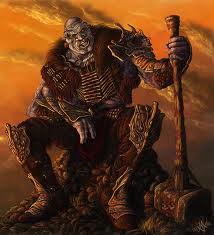
The Drune are a grey-skinned primitive race of savage humans residing in the Underworld. The Drune were once of the Tuatha, human worshippers of the Elven Ever-Queen, who fell into darkness and despair during the first Dark-Rise and thereafter pledged their souls to the service of the Dark. The Drune plot, gather and breed in the Underworld beneath the Middle Sea, carving out an Empire amidst the ghosts and undead of the dark caverns beneath the world of the living. With infernal patience they plot only one thing: the return of the Scourge to the world, bringing about a third dark-rise, and the destruction of all living things.

A warrior society led by demon-summoning Witch-Queens, the Drune gather in great numbers to- against all expectations of a death-loving people, fornicate- fight and revel. That they are mighty in numbers is certain to all those recognise their existence as more than mere myth. Why they yet wait patiently beneath the earth, rather than waging bloody war against the day-dwellers, remains one of the great mysteries of the Underowlrd.

The Drune are a violent people, placing no great value on any life other than their own, and who yet seemingly strive to fulfill their own earthly desires in every respect. Strength and a certain tolerance to pain are highly regarded throughout Drune tribal society, with the greatest warriors, priests and most successful child-bearing mothers marked by many scars and ritual tattoo's proclaiming their great prowess.

Though each tribe is commanded by it's own Drune Mother (A Druidess or Witch) and led into battle by its' Drune Priests, traditional human concepts of gender role do not exist beyond these two roles. A Drune war-chief is as likely to be female as male, and a Drune shaman or witch may be of either sex.

Drune Religion and Culture:

As well as The Scourge (whom the Drune know as the "Dark Mother') the Drune also worship certain demon lords. All are either explicitly allied with the Scourge (at least according to Drune Lore) or are said to share certain goals (Slough Feg, lord of maggots and decay is one such mighty demon lord). Drune armies consist of every man woman and child in the tribe -all living Drune are expected to fight when the tribe goes to war.

All Drune hold each others lives (even those of their children or siblings) as worthless while placing great value on their own. This high value placed on their lives might lead one to suspect that the Drune are cowards at heart, yet they fanatically embrace death as the ultimate form of union with the Dark Mother. Each Drune death, they believe, helping to bring about her triumphant return to wreath the world in darkness and decay. Rather than fearing death, each Drune merely seeks to embrace and experience as much of life as possible before that inevitable last sleep, when they are thrown into the tribes death-pits for their corrupt, earthly form to be feasted upon by maggots and carrion.

These death pits are also the favoured form of execution and sacrifice for prisoners captured in "war' against other tribes or in the infrequent surface raids (especially against the Tuatha) for new "breeding stock". The best of this breeding stock goes to improve the stock of the tribe itself, where the new stock might be mated to many different partners. The Drune have no concept of monogamy. Each Drune ruts with whichever other being -Drune or otherwise- catches their particular fancy. Though most Drune females are careful to avoid rutting with Cauldron-born -unless they wish to endure a particularly painful and grizzly means of achieving their final 'union' with the Dark Mother.

Drune Appearance:
Drune men are massive and bulky, veritable giants among men. Drune women however, are lithesome and svelte as vipers, dangerously (usually fatally) attractive to males of any humanoid race. It is hard to mistake a Drune man for anything but, what with their heavy facial scarring, tattoos and many piercings of bone and horn. Drune women, on the other hand, are more subtle in their physical variations from the human norm. Though they share the same, matt grey skin tone as the men, Drune woman do not scar or tattoo themselves as extensively. Instead, they tend to paint their lithe and seductive forms in a  variety of (often toxic) dyes, changing the design and pigments as the whim takes them. With their mastery of poisons, lotions and body paint, Drune woman are more than capable of disguising their unusual skin tones and make fearsomely effective spies. Any Drune encounter on the surface world (save for that with a full war-band) is likely to be with a lone female spy or small band of female scouts. Rumours of fierce "amazons" among the "Dark-Blind" surface worlders may be nothing more than the confused tales of terrified male survivors of such encounters. Such survivors -unless especially pleasing to their captors- are often permanently maimed by the fierce Drune females, but only after the women have their wicked -and all too painful- way with them.


Drune Women:
All the more fearsome and decidedly more evil and sadistic even than their men, Drune women delight in torture and bloodshed and exult in combining both of these "hobbies" with the practice of ritual sex and blood magics. Females think nothing of torturing themselves and even their own children in order to test the "strength' of their bloodlines. Like all Drune, Drune women train for battle and bloodshed. But whereas Drune men are huge and bulky warriors who trade blow for blow and sweep all foes before them, Drune women fight as skirmishers and light infantry.

Drune women excel in the use of daggers, javelins and other thin blades, often coated by painful poisons that cause paralysis (but not loss of sensation) rather than death. Not from any sense of mercy, but in order to better prolong the victims agonies.

Drune women also learn the arts of healing, but make no effort to counteract the effects of pain. Drune healing is as much about keeping captured prisoners alive for longer than it as about tending the torn, wounded flesh of Drune Warriors.

To a Drune, a wounded warrior or ill child will either recover or die on its own. It is this complete lack of the "mothering instinct' that makes Drune women so horrific in the eyes of civilised women, such as the matriarchal, female dominated society of Zama.

Drune At War:
A Drune horde on the warpath is a terror to behold. One that few disciplined armies can stand against without powerful magical support. That the Drune have not yet massed in great numbers to attack the surface world is a mystery beyond the reason of the wisest surface sages. Yet those who know of these terrifying beings are grateful that this remains the case.

Drune armies go into battle accompanied by the unquiet dead of the Underworld in all their forms, from soul-devouring monstrosities such as the Bodak to the reanimated remains of defeated foes. Their warriors forgo armour, shunning all forms of protection save for massive, fully enclosed helms. These helms are often decorated with demon horns with which to terrify their foes. Drune cavalry ride massive, demon-blooded horses that trail fiery from their eyes and whose hooves burn and sear the very stones of the earth they tread upon. Their warriors carry magically strengthened stone axes, arrows and spears into battle, often fighting alongside demons and in an uneasy alliance with allied tribes of Cauldron Born. These Orlocs, summoned by Drune Mothers, are born to an obedience that transcends their otherwise legendary libidinous lusts through strange and oft times brutal blood magics.

The tribes make war on one another only infrequently, preferring to war against the undead kingdoms of the Underworld. Even on those rare occasions when Dune tribes do fight amoung themselves the conflict is a highly ritualised affair; with weapons, numbers and even rules of engagement and time-limits agreed by the respective Drune Mothers before-hand. This strangely ordered attitude carries forward into the recreational internal tribal sports of the Drune, in which fatalities are common and the commander of the winning side sacrificed to the Dark Mother (as the Drune call the "Scourge") as a reward for his skill and faithful service.

Games Notes: The Drune are human characters (almost all of whom have heroic characters levels - mostly barbarian, assassin, druid, rogue or ranger) with the addition of the Dark Vision ability. if you're using the #rd or 4th ed rules, then a high proportion of characters have demonic blood and count as Teiflings or Cambions. Add Warlocks and Avenger (in 4th ed) to the list of common classes. Low physical stats are uncommon to the point of rarity due to their harsh up-bringing and a tendency to through sickly children into the worm-pits to die.

Inspiration for the Drune comes from the evil faction of the same name in the 2000AD comic and the Wendol as depicted in the movie "13th Warrior."Add in a healthy dose of S&M and Drow Paranoia, and you have the Drune of Zama.

Edit:
Development Notes: I created the Drune because I felt the need for an "Underdark' race that represented a foe as evil, devious and downright murderous as the Drow. However, I already had a surface dwelling race of "dark-elves" based closely on the legends of the Unsidhe and the Drow themselves were just so wrong for this particular game world. I wracked my brains for a while and, after picking up an old copy of 2000AD, hit upon the idea of adding the Drune to the game world.

Saturday, 23 April 2011

Zama: Cauldron Born

Overview:

The Cauldron Born: Orlocs to those who have faced them in battle. Each a tiny spark of the foul entity known as the Scourge. Each one brought into the world or slain by brave heroes brings the next Dark-Rise a little closer to the world. Yet not to kill them, is too allow rampant, monstrous evil to thrive and grow in the lands of the Middle Sea.


In ancient times, the Eladarin and the Tuatha knew them as the Fomori, the Sea Devils, for they came from lands beneath the sea. From the cauldrons of Sea Hags and Shark-Men to ravage the forest kingdoms of the Elven Isles (what mean known call Alba). Though beaten off in their early incursions, the deaths of so many such creatures, each carrying a tiny taint, allowed the Scourge to manifest itself upon the world, only to be defeated and thrust back to hell by the sacrifice of the Ever King, who consigned himself to burn in holy flames forever. (The information in this last paragraph is not general lore except among the Forsaken and the Eladrin, being unknown even to scholars of the other races).

Most terrifying of all, Orlocs are not born: they are made. In dark, alchemical cauldrons deep in the lair of monsters, witches, hags and warlocks, foul concoctions bubble into which the corpses of men, women and elves slain by violence are thrown, only to re-emerge mere hours later as full grown Orlocs of one sort or another. Ready to fight and kill for their new 'masters' -until such time as the Scourge calls them forth again.

These creatures seem both soulless and utterly fearless in battle (in game terms they never test  morale) unless commanded to retreat or withdraw by their summoners (prudent summoners instruct their guards to retreat when a certain number of losses have been sustained). Yet in other circumstances, such as when sacking a city, they are known to enter into a great frenzy. Though the cauldron-born cannot breed with one another, they can certainly produce more of their race through acts of procreation with (most of the rape of)  females of other species. In this matter alone, the drive for procreation, are the Orloc's summoners unable to control them. And once the drive to procreate has begun it can be difficult to stop. Many a Cauldron-Master has fallen victim to his own creations when attempting to prevent a mating -if only because the Cauldron Master knows that, while his own creations are fanatically loyal to his every whim and command, subsequent generations created through more "traditional' means are not so inclined.

The gestation period following such acts is terrifyingly quick ( a few weeks at most) and invariably kills the mother, giving birth to anywhere from three to a dozen tiny little miniature cauldron born who claw their way from the mothers belly and devour her. The strongest infants thereafter kill their siblings unless more meat is available and then slink away to find somewhere to gestate inside pod-like cocoons for a matter of days. Whereafter a fully grown Orloc emerges from the slime.

In this manner a conquering horde of Orlocs can grow to alarming proportions remarkably quickly. A force large enough to sack a village can, after only a few weeks and a mere handful of successful attacks, quickly swell to sufficient strength to sack a town. Hence the speed of response and great alarm caused when armies of the things crop up here and there around the countryside. Even the siting of a single such beast can call whole armies to arms, for such an infestation must be stopped dead before it has time to gain momentum.

Orlocs are not known to die from any means save violence. Disturbingly, even for those who have experienced such events before, when the death blow is struck an Orloc emits an eerie high pitched scream that can be heard for miles (alerting its nearby brethren to danger) and becomes suffused in a green light that seems to emanate from every pour or orifice, like a beacon. This is a light visible for miles on a clear night, and for several hundred yards even during the brightest day. Scholars believe that this is nothing less than a visible manifestation of the Scourge share being released from the dying beast, free to seek out other shards and gather to work it's evil upon the world once more.

Game Rules: Strictly speaking Orlocs are not undead -they have been reborn into new bodies, with a new 'soul' -or rather a small fragement of one immense, giant, alien soul that desires the eradication of all life from the material plane. In game terms they count as normal orcs, goblins, or whatever, with a default morale of fanatical and a minimum of half the maximum possible hit points for their type. Oh, they will try to capture -rather than kill- female characters. They will try very, very hard indeed. To the extent that they will pursue a band with at least one female character for weeks if neccessary -or until another, more defenceless female catches their eye.

Note: The tendancy of these creatures to go berserk with lust at the sight of a female of reprodutcive age does not, strangely, seem to apply to their summoners. Indeed, on those rare occasions when a Cauldron-born has mated with a (willing) female summoner, the result has been the natural birth of those rarest of creatures: a half-orc.


Goblins:

Gestated from the bodies of small, murdered children or (in far rarer cases) from the bodies of halflings, gnomes or other small Fae. Goblins are swift, sneaky and murderous. The advance scouts and archers of an Orloc force, they above all others are likely to demonstrate small acts of rebellion towards their summoners, twisting their order to follow the letter but not the spirit (or vice versa) or else leave small indications of their presence nearby (small, tortured animals and birds) in the hope of luring 'breeding stock' to their lairs.
Goblins stand approximately three to four feet tall, are more intelligent (or rather cunning) than their taller, stronger brethren, and more prone to acts of sadisitic savagery from sheer boredom.
They are usually the first to break the metaphorical chains binding them to their summoner. Like all Cauldron-Born, their eyes are suffused with an eerie green glow (not shown in picture). Like their hobgoblin brethren, they tend towards orange, rather than green, skin. However, greenish skin tones are not unknown.

Hobgoblins: 

Hobgoblins are the transformed remains of adult or adolesent humans and similarly sized, non-fey creatures. more ordered and disciplined than Goblins, they are more apt to obey orders and more inclined to use their own initiative. Like all Orlocs (whether true cauldron-born or from later generations) they are fearless in battle. Though not as cunning as their lesser goblin brethren, they seem to be capable of tactical thought and co-operation. While goblins fight as individuals, unless specifically ordered not to, Hobgoblins instinctively gather together to forms ranks, mobs and warbands and take to more discliplined fighting styles with little training.
Like all Orlocs, they possess eerie, glowing green eyes. They stand man-tall and, though all are male, some possess a more feminine shape - a legacy, perhaps, of the corpse from which they were transformed. Hobgoblins possess orange skin tones.

Orcs:

According to the tales of Elves, while Orcs were once the most common form of Orloc, they have dwindled in numbers to be greatly eclipsed by the hordes of goblins and hobgoblins that now periodically swarm across the land. Said to be born from the corpses of Eladrin, Forsaken and other man-sized fey, if the hobgoblins and goblins are a twisted reflection of the inner evil within every human then it follows that, as reflections of the creulty inherant within each living fey, that orcs should  -and indeed do- far exceed their brethren in the monstrousness of their form. Some scholars believe that certain orcs -those of a more aquatic appearance- are developed from the corpses of Shark-Men, Merfolk, Sea-Fey and other legendary beings that exist below the waves.
Duller and seemingly more stupid than their goblinoid cousins, Orcs are fractious and prone to self-destructive acts, as though some small part of the original; fey soul survives and wishes to bring about it's own destruction. Doubtless, not from any concern with regards to what it's newer, baser form might do in pursuit of it's lusts, but from sheer horrow at the ugliness of it's new form. Eladrin scholars believe that, with the Orcish Cauldron-born at least, the Scourge permits some small vestige of the original soul to remain, if only to more intensely savour the torment and degredation of the lost soul's condition.
Orcs tend to be large, brutish and malformed in some way (evil eye, oversized limb, undersized limbs, hideous warts, hideous stench etc). They also tend to be green skinned.

Fomorian Giant:

The rarest of all Orlocs, the Fomorian Giants appear much the same as orcs, save many, many feet taller. Most are grown from the corpses of Firbolg (or were, in ancient times at least) but others are born from murdered or slaughtered giants and ogres of all types.
Similar in appearance to their orcish brethren, they are, if anything, even more malformed than their smaller, orcish brethren.

Edit:
Development Notes: The Cauldron-Born are a very recent addition to the Zama setting. For years, despite the nagging of my players and my own conscience, I refused to have tolkein-esque non-human races on Zama. Even faeries and giants were rare -almost unique- in the game world, and followed traditional mytholigical, rather than D&D-style, themes. Until, that was, I saw the Immortals in the movie 300. At which point I reluctantly allowed the players to convince me that humanoids could be added to the setting. To this day, I'm still not 100% happy with their inclusion. At any moment, I might decide to write them out of the worlds history altogether, or, at the very least, come up with a way to make them extinct.

Friday, 22 April 2011

Zama: The Bronze Legions


Known as the Bronze Legions, the Army of Zama represent the finest disciplined fighting force the lands of the Middle Sea have ever known. Though heavily outnumbered, time-and-again this mighty force has beaten back the fiercesome Mantis Legions of the Arcane Imperium. Were they not governed by the all-encompassing constitution of the Protectorate of Zama, a constituion that forbids the Bronze Legions from taking the field in a war of aggression, they could indeed have conquered the world.

At the core of this mighty armed force lies the Sacred Band, a body of professional soldiery recruited from every city of the protectorate, yet only from those of true Pheonixian blood. The 13,000 men selected to serve and die in the selected band are conscripts, recruited on pain of sacrifice. Yet to call this a conscript army is perhaps a disservice. Zaman boys at their childhood battle drills dream of donning the purple cloak and rune-encrusted bronze of the Sacred Band. An honour that, in nearly two thousand years of recorded history, none so-chosen have ever refused.

To join the Sacred Band is to be elevated to the ranks of a noble brotherhood, a warrior-society without equal in all the world. For while the professional warriors of other lands and cultures often die in training, none-so-many die in the attempt as those who seek to join the Sacred Band.

Always 13,000 strong, the Sacred band recruit from those who have attended and trained at the Dogi, the most brutal and effective warrior academy in all the Known World. From the age of twelve the conscript cadets, none of whom are ever addressed by their real name, but merely by a coded series of numbers of letters, strive to prove themselves worthy of the honour they have been selected for. Only in times of great calamity, when the Band's numbers have been depleted too badly for the graduating soldiers of the Dogi to fill the ranks are adult soldiers, the elite of other Zaman fighting men, admitted to this sacred religious order.

For the Sacred Band are not just soldiers. They are a warrior and religious elite, the Temple and Palace Guards of the Holy City of Zama and the Queen herself, a direct descendant of the Goddess Tanith.

Promotion within the ranks of the Sacred Band is earned by merit, not birth. Yet the Dogi is not a school of reading, writing or history. It is a school of war. And therefore, only those supplicants with the best educations prior to joining the Dogi, specifically those from rich or noble houses, ever rise to high rank. The sole exception is the Prince Archon, the Champion of Zama and leader of it's armies. The Prince Archon is chosen, by the Queen, to be her representative on the battlefield. She may chose any man for this task -but with two restrictions. He must be a member of her family, and he must be acclaimed by the man of the Band.
The current Prince Archon, Hamilcar, the Queen's Brother, has only recently come to replace her husband in this role. Yet even prior to his ascension his name has been legend. The Commander of the Blood Gates, the sole Pass into the lands of the Protectorate from the territory of the Arcane Imperium, he has already led the armies of Zama to Victory in eleven battles, and has been prophesied to lead them in many more. The Prince-Archon holds a place in the Zaman heart and the Zaman religion second only to that of the Queen herself. For just as Zama's Queen is the heart of the Goddess Tanith, so Zama's Archon-Prince is the mortal swords of it's Gods.

8000 men of the Sacred band fight as heavy infantry, forming phalanxes in battle armed either with long pikes or heavy spears, short swords and great, heavy round shields. Encased in rune-enchanted bronze chest-pieces, greaves and helms and wearing their mighty purple war-cloaks, they are the finest heavy infantry in the world. As immovable as a mountain.

Another 2,000 men of the Sacred Band, those afforded as they very best, ride into battle atop mighty warhorses. Known as the Companions, they fight equally well afoot as mounted and serve as the bodyguard and battle-companions of the Archon-Champion himself.

Last among the Sacred Band are the 3000 men who serve as Marines to man the mighty war-ships of the fleet, ten marines to a vessel. Though the ships of other navies might augment their rowers with as many as 40 to 100 marines, the men of the Sacred Band are no mere mortals. They go into battle even as sea in their heavy-bronze armour and long spears, allowing ten men to match against forty or fifty lighter armed marines of other nations. Unlike these other marines, who are expected to board and capture a ship, it is the task of the Sacred band merely to defend their own ship from boarders. The navy of Zama has no need to capture the inferior ships of enemy nations, preferring to send them to the bottom of the sea. Thus, the marines need only defend the narrow prow of a Zaman ship until it's ram is withdrawn, whereupon the enemy vessel sinks swiftly beneath the ways.

 Zama’s navy consists of 250 fast quinqrimes and quadrimes augmented by about 50 tiremes act as scouts and messengers rather than warships. The ships of the Bronze Legion are crewed by well paid sailors recruited from Zaman families and accompanied into battle brothers of the Sacred band. In the face of the Arcane ImperiumsZaman sailors belong to the Peoni and don their armour and weapons before entering battle, heedless of the dangers of drowning. 


Though mighty indeed, the veteran warriors of the Sacred Band are few indeed, and this go into battle backed by Citizen Conscripts (the Peoni) and Mercenary Infantry.

In the nation of Zama, it is the task of women to rule and men to fight. Hence the Peoni number amoung them every male citizen of fighting age in the Protectorate.

Men of the first class equip themselves as Hoplites or Cavalry, armed with weapons identical to those carried by their brothers and cousins in the sacred band, with the exception that their own weapons (but not their shields) are made of plain iron or steel. Not the enchanted bronze of the Sacred Band. The second class also arm themselves with bronze shield and iron or steel spear, but their armour is as likely to made of linen as steel or bronze. The men of the third class fight as light infantry, armed with spear, shield and short sword, trained to harry the flanks of foes attacking the phalanx and to protect the phalanx in turn. Finally, the poorest men (those unable to afford even a single slave) are expected to arm themselves as archers and javelin men. A function that carries with it little or no shame and affords the opportunity for a brave man to enrich himself through plunder.

Zama only calls out the militia of any given city when the city itself is directly threatened. Thus the Peoni, while well trained, are under-used and lack experience in war-time. Zama makes up it's battlefield numbers with thousands of mercenaries, desperate and adventuresome men drawn from all the lands of the Middle Sea. Even in peacetime Zama may have as many as 10,000 or 12,000 mercenaries in service, or as many as 100,000 in times of war. Zaman mercenaries are grouped by nationality into Companies of a thousand men, each led by a Drakos (or Colonel) drawn from the Sacred Band.Zama engenders more loyalty in it's hired soldiers than most- the outer ring of the city is named the mercenary quarter, for the many soldiers housed therin. Living so close to the city they fight and die for, many such mercenaries settle down roots, marrying local Zaman women or freed slaves, and become eventual citizens of the City-States for whom they fight and die on a regular basis. And, to further ensure the loyalty of this multitude of paid killers, Zama honours and pays it's mercenaries like no other nation in the world.

Finally, the shock troops of the Bronze Legion serve to terrify horses and men, winning battles it seems, often on their own. Each family of the Eighty, the leading houses of Zama, is required by law to maintain one war-elephant for the Protectorate.Stationed one to each of the eighty towers that line Zama's outer wall, these beasts go into battle clad in thick bronze and bearing armoured noble men of the eighty families on their back.
An almost irresistible force on the battlefield, Zama's armies know that where their war-elephants go, victory is sure to follow.

Edit:
Campaign Design Notes: As you might have guessed, the Bronze Legions are derived from the Carthaginian armies of the Punic Wars with a heavy dose of Spartan military theory and discipline thrown in. Although not all the men of Zama are trained in Spartan methods, the Sacred Band certainly are, though they start a little later in life than their real-life Spartan counterparts.

Traditionally, Carthaginian mercenaries were a lot less dependable than Zama ones, but just as Carthage had a "Mercenary War" so did Zama -although Zama learned a lot more from it's previous mistakes. Likewise, Carthaginian militia were not as effective in the later Punic War period than the Zaman's pictured here. While Carthaginian men grew soft and complacent behind their mercenary armies, the men of Zama most assuredly have not.

Jack Chick has no idea...


Some pictures really are worth a thousand words.

Monday, 11 April 2011

Zama: The Arcane (Aryan) Imperium

The Arcane Imperium is a blasted, vile wasteland inhabited by godless demon-worshippers and ruthless conquerors. Driven by the need to acquire fresh slaves and fertile grazing lands, it's ruling Senate of demon-blooded cambion spell-casters strive to greater conquests, to enhance the already powerful prestige and dignitas of their accursed realm -and to bring all the gods-sworn of the world under the terrifying rule of the Mantis Banner. No law exists save that a man can claim for himself at the edge of a blade, demons, devils and worse stalk the alleyways and flat rooftops while bodies lie rotting in the streets. It is an empire built upon fear, greed and the pitiful weeping of enslaved nations.

Fifteen hundred years ago, a fleet of ships under the Priest King Arias fled the destruction of the old Punic Empire. Yet where other such fleets found safe harbours and gentle winds, the people of Arias were plagued by storms and sea-monsters, loosing half their number and more to the perils of the journey. Arias himself lost his wife and children when a great wave struck his ship, driving it onto the rocky shore even as he grave praise to the Gods for his deliverance.

Raging in his grief, he denounced the worship of divine beings and cursed the Gods themselves. Upon making landfall at the city that now bears his name, he slaughtered all those in his company who would not forswear their oaths to the Punic Gods and devoted himself to the worship and adoration of demons and devils thereafter.

Following the lead of their King, the people of Arias soon came to abandon worship of the Gods entire, even in secret, and so the lands about their new Kingdom grew fallow. With no gods to manage the rains and winds of the land, the new Kingdom soon became a wasteland, giving the people of Arias yet more reason to despite the divine beings they once worshipped and driving them further into the embrace of evil

In desperation to acquire fertile lands and the vast number of slaves required to eke out the barest growth from the blasted lands about, the folk of Arias were driven into a never-ending cycle and conquest and growth – for no worship of the divine is permitted anywhere in Aryan territory and any new territories quickly become as blasted and barren as the city of Arias itself.

In recent decades, the Senate of Arias, having long since displaced the ruling line of Kings, have sought to feed their growing populace not through conquest but through trade, as much from realising they will soon run out of land to conquer as much as from any desire for peace. And yet the Senators, both young and old alike, still yearn for war and conquest, for nothing so enhances the political prospects of a family than the defeat of the Imperium's foes. Yet the calibre of foe required to sustain a long-term war without resulting the acquisition of new conquests is great indeed, Fortunately for the power-grubbing, war-mongering cambion spellcaster's of the Senate, such an enemy exists in the military and mercantile power-house of Zama. This rival, non-expansionist city-state's control of the vital grain trade – grain vital for the continued existence of the Imperium as a viable state- provides the perfect excuse for war -a war that the Imperium has been waging (and loosing) consistently for nigh on fifty years.

The enslaved peoples of the Middle-Sea are kept docile by the implied possibility of freedom and even citizenship for future generations. This citizenship is no empty honour. Imperial Citizens are legally permitted to made pacts with demons or devils and are entitled to certain protections (enforced by the soldiers of the Mantis legions) throughout the lands of the Middle Sea. Imperial merchants, tax-farmers and even criminals can walk the streets of foreign cities plundering and grafting at will, knowing that no citizen of the land in question would dare risk the wrath of the Imperium by taking action against them. For any given Imperial citizen might be one of the feared Arcanum, the magic-wielding secret police and assassins of the Imperium. Any such transgressor is likely to waken in Hell itself, the personal play-thing of some demonic creature summoned for that very purpose. The Arcanum see and hear all and are all to likely to report any harm or insult done to an Imperial citizen -and therefore, by extension, the Imperium itself- to the eager and all too- rapacious ears of the Senate whose greedy conscript fathers eagerly grasp any excuse to further stretch the shadow of the Mantis over all the world.


Edit:
Development Notes: The idea for the Arcane Imperium came from two main sources: the Masters of Rome series of books by Colleen McCullough and the Principlaties of Glantri from the D&D setting. At first the Imperium was just the Late Roman Republic with the caveat that all the Senators had to be arcane magic users and all "priests" had to be elected officials rather than clerics (who were banned from the Imperium due to the failure of the Pheonixian Priest Kings to protect their people).
At first, the Imperium expanded it's borders for much the same reason Rome did. but then I was inspired by the ancient Roman notion of making "bargains" and "contracts" with the Gods. 
"If you do this for me I will sacrifice X white horses in your name" and so on. 
So I figured, why not have the Imperium turn away from Gods and Goddess altogether, and have them make deals with devils and demons instead. This idea expanded further. What would happen, I wondered, to a land where no Gods were worshipped, in a world where the Gods themselves determined weather patterns? The answer was the Blight. The barren wasteland found within the boundaries of the Empire. Suddenly, the Imperium had another reason to be fighting constant wars of expanions. No longer just to feed the power-lust and prestige of the Senate, but to feed the very people of the Imperium themselves.

Saturday, 9 April 2011

The Shorn Triumphant

Sessions 7 and 8 of my ongoing OSRIC Karameikos campaign (featuring Dungeon #58's Trial of Champions) are now up on the Obsidian Portal site and can be read here.

4th to 10th Flaurmont
Leaving with Stefan the next morning, the party spends a a miserable three rainy days travelling downriver by boat back towards Kelvin. Perhaps it is the rain, or else the poignant reminders of their two missing comrades, but regardless of the cause The Shorn are considerably more subdued in this latter journey. Stefan tries without great success to bolster their spirits by regaling the youths with tales of heroic triumph in the face of adversity.

On the evening of the third day, the riverboat makes port at the quays of Kelvin. Stefan leaves the group there, informing them that he will be staying at the Merchants Weigh Inn for the next few days should they decide to accompany him back to the family farm. Keen to keep a tight grasp on the party purse strings, Hans refuses to allocate funds to staying at the Merchants Weigh and so the party spend much of the night searching the dock and trade quarters for a decent but reasonably priced place to stay. At one point, they hear sounds of a scuffle in a nearby ally, including a few pleading calls for help. The dwarves are eager to assist but, after a stern admonition from Hans that they are no state to do other than mind their own business, the dis-spirited party carry on.

Eventually the find rest in the Duke’s Arms, little more than a working man’s tavern with a few beds set aside on the top floor for patrons who have imbibed a little too much to be trusted to safely make it home. There, in the tap room, they hear more rumours about the brigand Skarda and his raiders. It seems yet another village in the neighbouring kingdom of five shires had been burned and looted, it’s inhabitants carried away to who-knows-what-end by the evil raider and his mysteriously vanishing warriors. Perhaps wisely, the Shorn realised that this particular foe was not for them, at least not until they were older and wiser. More promising news surfaced in the form of the main topic of gossip in the tap-room that night: The Shorn festival would begin on the tenth, with games , music and feasting galore. Not to mention the highlight of the event: The Trial of Champions, in which teams of the newly Shorn would demonstrate their worth and ingenuity in overcoming a series of ten perilous tests. Intrigued, the party decided to make their way to the Caravan fields on the morrow to learn more about the upcoming trials.

So it was that they took to their beds early, thankfully to soon to overhear talk turn to tales of a merchant from up North named Caldwell who’d been telling all and sundry about the “terrible betrayal” of an adventurous band of Shorn who had taken up his offer of employment only to leave for distant parts without bothering to finish the job. That lot, it was generally agreed by the locals, would not likely do well in the trials at all.

That dawn, the party made their way to to the Caravan fields to register for the trials. They learned that they would be required to enter the arena (actually a winding series of tents containing a number of
unbeknownst to the characters

illusionary chambers with hidden gantries from which the crowds may watch) clad only in normal clothing and without weapons. Spell casters were warned that they would be permitted to cast no prayers or spells save read magic and that they should therefore prepare their spell selection accordingly. The master of the trials assured the party that any weapons they would require would be provided for them. The last admonition was that any team found to enter the Arena under the influence of any magical effects or carrying any magical items whatsoever would be disqualified. Now, they had only to determine a team name for themselves and await the day of the trials: the tenth.
 

On the way back to the Inn, they learned that a prominent city merchant had been murdered the night before, presumably by a love rival; that the suspected murderer had fled the town and that both families were now likely making preparations for a covert war of murder and assassination.

If any of the Shorn felt guilty at the news, they passed no comment.

The day of the trials dawned clear and bright, and the Shorn made their way through already packed crowds to the starting pavilion where they were met by the master of trials and announced their new team name (“The Dragons”). There, they were mocked by a particularly disreputable seeming band (more brigandly than adventurous in appearance) led by a particularly noxious dwarf by the name of Dolgrim, seemingly the leader of a band calling itself the Skull Legion. The party denies the dwarf his offer of a friendly wager and settle down to wait their turn.

The party, when called, overcome nearly every challenge with a perfect score, dropping a total of only twenty points throughout the course of the competition and even coming up with several novel solutions (other than those devised by the Master-of-Trials) including:
  • Making their way past a pair of Iron Cobra guards equipped only with Dust of Invisibility and Dust of sneezing -and not knowing which dust is in which pouch.
  • Retrieving a prize from within the gullet of purple worm.
  • Safely crossing a river infested with man-eating piranhas.
  • Successfully crossing 30ft of green slime to open a locked door
  • Successfully crossing a wide pit at the bottom of which slumbers a deadly dragon.
  • Scaling a sheer cliff equipped with nothing more than a scroll of rope trick and a rope that’s too short.
  • Successfully and safely travelling down a corridor filled with lava and warded by a pwerful fire serpent.
  • Boindil single-handedly rescuing the rest of the party from a castle dungeon (despite sending his animal messenger down to the bound and gagged prisoners to ask the self-same gagged prisoners (did I mention the prisoners were gagged) if they had any ideas.
  • Sneaking past a bear guardian blocking a tunnel without actually harming it.
    Solving a magical-door puzzle using the prizes obtained through earlier trials.
The party emerged victorious, scoring higher than any other group and placing three members on the podium for the individual “class” competition as well. Boindil, despite his slight error in the dungeon rescue scenarion, managed to win the cleric even, with Elra coming third in the wizards even and Hans coming second in the fighter category. Medals and trophies were awarded by Baron Desmond Kelvin (including a generous cash prize which the dwarves immediately tried to claim as “gear money” only to be shouted down by the three companions who wanted to pay Artax the Sage the remainder of the funds they owed him).

During the festivities, much to his awe and surprise, Hans was approached by the famous adventurer and Lord Knight of Verge, Ser Retameron Antonic. Retameron, Knight and Lord of Han’s home village and a former student of the knights sword-master father, Teranon. The famed adventurer commented that the group had done much to redeem their “frankly appalling” reputation by winning the Trial of Champions but suggested that they fetch themselves back to Threshold to fulfil their obligations and pay their debts right quick, before the “shine of this latest and (so far only) notable achievement loses it’s luster). The party agree to return North with him tomorrow and further agree to spend the next night as guests in Verge before continuing on to Threshold. However, the seasoned adventurer warns the party that a second party hired by Caldwell has already ventured down in the second level of Castle Caldwell in their absence, and has so far failed to return.

With that dismal thought, the suddenly sober Shorn once more make their way to bed,puasing only to send Stefan a messenger explaining that they will not be accompanying him to his farm after all.

Tuesday, 5 April 2011

Zama: Index

Zama is my home-brew game world, the setting for many of my short-stories and a never-finished series of novels. Like the Forgotten Realms, it has undergone many cataclysmic changes (coinciding with every change of edition) and will, in my next campaign, likely undergo another that will reset the world from 4th ed physics to an earlier edition of the game.

At the moment, the Zama setting is not presently in use – at least, not unless of any of former players are using the setting for the own games. Not all that unlikely a possibility come to think of it. Not when you consider I've been running games in this world for over twenty years.

The entries here are for Zama in it's present, early-Iron Age incarnation (prior to the fall of the Punic Empire the campaign had reached the late-medieval epoch in technological terms albiet not sociological ones). The information presented here will likely be out of date by my next anticipated visit to the campaign-world; in which I will probably adapt the world to an early-mid renaissance setting.

Here's a partial listing of my current and intended entries. As time passes I'll develop the listed articles and  add more to the list

Arcane (Arian) Imperium:
Evil empire dominated by a Senate of arcane spellcasters and their demonic allies

Bronze Legion, The:
The fighting men of the Protectorate of Zama. Link

Cauldron-Born (Orlocs):
Foul creatures birthed from infernal cauldrons fueled with the bodies of the recently dead, slain by violence. Link

Citadel, The:
Known as the city of Gate Pass, an independant city-state which lies within the canyon seperating the lands of the Arcane Imperium and the Protectorate of Zama.

Drune, The:
Renegade Tuatha who have turned from the worship of the Earth Goddess and embraced The Scourge, whom they know as the Dark Mother. Link

Everqueen, The:
Immortal Queen of the Fey and patron goddess of the Ghale Shee (the Elves of the Otherlands). Fickle, Capricious, Ruthless.
Forsaken, The:
Elves. Those of the Ghale Shee who have displeased the EverQueen. The undergo a painful transformation, sterilisation and banishment to the world of men.

Heroes:
The adventurers, both villainous and heroic, who inhabit the lands of the Middle Sea.

Monsters:
The origin of the unique (and near-unique) monsters that plague the lands of the Middle Sea.

Non-Humans:
The non-human PC races of the Middle Sea.
Otherlands, The
Home of the EverQueen, the Ghale Shee and the land in which faithful Tuatha dwell to await rebirth into the next life.

Pantheons:
The world of Zama has but one Sun God, one Sea God, one Storm God. But it has many pantheons.

Scourge, The:
The terrifying malevolence that seeks to re-enter the world and destroy all life within it.

Underworld, The:
The dungeons of Zama are more than mere ruins. Many lead into the very depths of the Underworld itself, where damned souls reside for all eternity.