Showing posts with label Digging the Sandbox. Show all posts

Saturday, 9 June 2012

OSRIC: Religion, Morality and Alignment


One thing's for certain, I really need to find a new name for my War of the Roses OSRIC campaign. Something a little catchier. OSRIC: Age of Anarchy, perhaps. What do you guys think?

Anyway, one of the (slightly) different things about this campaign is the way I'm treating alignment. Rather than doing away with the concept altogether, except for extremes of good and evil (as I often do) alignment with be replaced by moral codes and religions. This is still a work in progress at the moment, but the options at present are:


Religious Alignment Choices:
  • Medieval Catholicism
  • Medieval Islam
  • Medieval Druidism/Paganism
  • Medieval Judaism
  • Medieval Orthodox
  • Servant of the Dark One (NPC Only)
 The religion based alignments are the most nebulous of all in a very real sense. For example, most of the major religions have a variant on "though shall not kill". As mentioned in a previous post though, Catholics believe that only humans have souls, so this rule only counts towards killing humans. That being said, for a Catholic it's perfectly acceptable to kill a human if he (or she) is a non-christian, or if you're a member of the knightly and noble caste (because god has ordained that you are born into a role that requires killing) and have a fairly good reason for doing so.

So, these five choices aren't quite the straight-jacket they might first appear to be.

Then we have the (sometimes) more restrictive, properly fixed moral codes:
Rashi, perhaps the best known medieval Rabbi and Scholar

Moral Alignment Choices:
  • Athiest/Agnostic
  • Chivalric Code
  • Humanist
  •  Irreligious
  • Secular Devotion
The Humanist and Chivalric moral codes are perhaps the most tightly restrictive in a sense that they have fairly well defined limits. Like everything else, of course, there are loopholes to exploit, but the Chivalric code especially is fairly well defined. The irreligious and atheist/agnostic alignments give the greatest freedom of action of all, perhaps equivalent to true-neutral in the traditional D&D alignment spectrum. Basically, such people are limited in their actions only by the actions and the beliefs of the authorities around them.

Lastly, we have Secular Devotion, which implies an utter adherence to an NPC secular authority such as the King, a Duke or Earl or even simply a friend or loved one. The limitation here is that the character won't do anything to act against the interests of the object of his devotion, but at the same time the character would be reluctant to disobey any instructions from this same NPC, regardless of how abhorrent. Most of the lower-end bad-guy NPC's in this game will have this alignment, which is very similar to lawful neutral in many respects.

Finally, we have good and evil
Salahadin: A great example for Islamic Paladin characters

Good and Evil:
Good and Evil, Law and Chaos no longer exist in an alignment sense, but they do still have a place in the game world. Generally, for a creature of being to be affected by such as a spell, they must have a history of routinely acting in a certain way. For example, angels and demons are always affected by spells that affect good and evil creatures respectively. A knightly character who consistently acts to uphold the law and maintain stability in the land (regardless of his actual alignment) would be affected by spells such as Protection from Law. A robber-knight on the other hand (or one notorious for changing sides during the Wars) would be affected by Protection from Chaos and so on.

Alignment and Clerics:
Clerics, strictly speaking, can be of any alignment, not just the alignment of their religion. However, if they wish to retain their spell casting abilities, they had better ensure that their actions remain consistent with the tenants of the religion they represent. Thus, a Catholic cleric might have the Secular Devotion alignment, and be devoted to the service of his brother, an NPC Lord. He might politic and preach on his brothers behalf without effect, but if he arranges the assassination of his brother's enemies, he can kiss those clerical abilities of his good-bye.

This helps to explain why so many priests in the historical time period (and setting) can act contrary to the interests of their religion and still remain priests. In a gaming sense, the ones that manage to obey the tenants of their religion can perform minor miracles. The ones who betray their religious beliefs in favour of more secular or personal concerns, lose their powers. Often very early in their clerical careers. The few who manage to exist in the secular world and remain true to their faith are essentially minor miracle workers, moving to become widely recognised as living saints (or prophets) at higher levels.

Pope John XXIII. A fine example of a priest who most definitely would have lost his cleric powers in this setting.
 All these concepts are just skeletons at the moment, in need of a great deal of fleshing out. But that's where the alignment system remains at the moment.


Tuesday, 29 May 2012

WoTR/ToEE Campaign: 17 Things You Need to Know

17 things my players will need to know before the start of the new campaign:

Choosing Sides: White Rose of York or Red of Lancaster?
Setting

Recent History:
  • In 1455, under pressure from the Pope (who had threatened to excommunicate the whole of England), Richard, Duke of York, leads fully half of England's nobility in revolt against the Lancastrian King, Henry VI. A weak and insipid ruler, Henry had allowed himself to fall under the sway of dark magicians and demonologists.
  • In 1471, the Yorkist faction finally put an end to the Wars. The Yorkists (fighting under the banner of the White Rose) defeat the Lancastrians and their demonic allies at the Battle of Tewkesbury. Following the battle, the Earl of Angstford and his family, stout Lancastrians and fearsome demonologists, have their lands and titles placed under attainder, (confiscated), by the Yorkist King Edward IV. They flee in various directions: to France, Burgundy and Ireland.
Henry VI, executed soon after Tewkesbury
 Current Situation:
  • The current year is 1481. Edward IV still rules England.
  • With the great mass of English chivalry dead on the Bloody Meadow of  Tewkesbury or in exile abroad, much of the country remains ungoverned and lawless. Many heirs are still too young to inherit their lands. Other lords and knights still retain their lands but live in Exile. Brigandage is common. The monstrous creatures forced into the Wildwoods by the campaigns of Arthur and St George are now once again venturing forth into the settled lands of England.
  • The seat of the Earl of Angstford remains vacant, a tasty morsel dangled before the nose of several important noblemen of dubious loyalty as a means of ensuring their good behaviour. The few castles and manor houses within the limes (territory) of the Earldom which are not razed or ruined, are held by Flemish mercenaries in the service of the King.
  • Women are expected to marry and raise children or take vows as a Nun. HOWEVER, female mercenaries and adventurers are actually quite common in this period, but are viewed as abominations by most "right-thinking" folk.
  • Some new items not normally found in the OSRIC rules are available, but are well beyond the means of most starting players. These include: Arquebus/Hackbutts (primitive handguns), Field Plate Armour, Full Plate Armour (better versions of Plate Mail) and Brigandine Armour (actually quite common, I'll probably post the rules for these)
Religion:
  • According to the Catholic church, only humans have souls (and possibly Half-Elves and Troll-bloods, but the church isn't sure about that).  Killing animals or members of any other race is NOT considered an act of murder by Catholics. Muslims and Jews believe that Dwarves also have souls. The Muslim and Jewish religions have not had sufficient contact with Elves, Half-Elves and Half-Orcs to have formed an opinion regarding the status of these beings one-way-or-another.

Geography:
  • The campaign will be set in the fictional English Earldom of Angstford. Although there are road and other physical connections to the rest of England, the territory  of the Earldom represents the physical limits of the campaign sandbox. In theory, your characters can leave at any time. In practise, please don't.
Edward IV, Yorkist King of England
Game Information:
  •  Races: Player Characters may be Shidhe (Elves), Changelings (Half-Elfs), Dwarves, Humans or Troll-Bloods (Half-Orcs descended from Fomorians). There will be no gnomes or halflings in this setting.
  • Class and Level Limits: Unlike the previous game, humans will not be able to multi-class. Non humans may multi-class as normal but be aware that maximum levels for non-humans apply in this setting with the following exceptions: Dwarves and Trollbloods may advance to any level as a fighter or Barbarian. Elves may advance to any level as a Magic-User or Illusionist. Changelings may advance to any level as a Houri, Thief or Ranger.
  • PC Clerics may follow one of three religions: Catholicism, Islam or Judaism and may be of any alignment. However, Clerics must always act within the bounds of their religion. Carrying out actions forbidden to their religion (for example: theft, sexual intercourse or murder for a   Catholic Cleric) will result in the character losing their spellcasting abilities. Only NPC Clerics may be followers of the evil deity known by various names such as the Dark One, Satan etc. PC Clerics ALWAYS turn undead (rather than control them) regardless of their alignment. Clerics of the Dark One always control undead.
  • All Clerics are Priests of their religion. However, not all Priests are Clerics. Clerics are essentially proto-saints at low-levels and actual, living saints, prophets or the equivalent by higher levels. Spell-casting priests (i.e Clerics) are said to possess Grace, as in the "Grace of God". Perhaps one Priest in ten in so blessed.
  • Druids are, well, druids or witches. They are often mistaken for servants of the Dark One and burned at the stake.
  • Wizards and Illusionists are, likewise, often mistaken for servants of the Dark One and burned at the stake. Most pretend to be "astrologers", "sages," "natural philosphers" and the like.
  • Elves may not be Clerics. They may be Druids instead.
  • Paladins do not belong to an Order of Knighthood. They might not even be knights. They do not hold any official place in the hierarchy of their religion, but may eventually be recognised as "warrior-saints" by their faiths. Salahadin and Sir William Marshal are perhaps the best historical examples of individuals who behave in a Paladin-like manner.
Do You Want To Know More?
Click the link for a good grounding in recent events.

Friday, 25 May 2012

Temple of Elemental Evil: War of the Roses Style.

Now that I spend about 10-12 hours a day painting figures for a living, the Isle of the Earthshaker campaign has pretty much died. I was largely making up dungeons and encounter locations as I went, so prep time for each weekly game was fairly considerable. I just don't have the free-time anymore to put so much work into writing a campaign.

The solution is to re-start with a published campaign, fleshed out with a few extra adventure locations from published modules. I had an inkling to convert the WFRP 1e Doomstones campaign back to it's original format (AD&D) but that would be a fairly substantial task. Plus, the story driven nature of the game makes regular attendance by the same group of players pretty important. That isn't really compatible with my current group's"sit-in when you can" style of campaign play.

So, I'm thinking of running Temple of Elemental Evil. It has it's flaws, but it should do the trick. I'll take a look through my early module collection for an alternative, but I'm thinking Temple of Elemental Evil for the main dungeon, Stonehell Dungeon as an alternative location nearby and simply sticking other adventure locations from modules on the map as and when required. Not exactly a masterpiece of creativity but it'll do.

The twist is that I'll be setting it in an alternate-earth version of Real-World history during the War of the Roses.


I have a few ideas in mind that need fleshed out. For the moment, Clerics and Paladins can be Christian, Jewish, Muslim or Servants of the Dark One. Druids are, well, druids. Wizards use coin magic (spell preparation consists of enchanting small coins which unleash the magic contained within when thrown),  Elves come from the wildest, more remote parts of Wales, Ireland and Scotland and are more British-Fae elves than they are Tolkeinesque. Half-Elf's are called Changelings, Dwarves come from Scandinavia and can be found in parts of the British Isles settled by Vikings (yes, Dwarf Vikings!). Half-Orcs are humans with an ancient Fomorian bloodline, rather than being actual half-orcs.

All humanity knows that the legendary creatures of fire-side tales and dark, ancient myths still lurk in the wildwoods, driven from the lands of humanity by the likes of the Sainted George and King Arthur in the distant past. From time to time, a village is burned, crops or beasts are stolen and children vanish. All know this to be the work of creatures from the wildwood, and every house in Britain keeps an iron horse shoe above the door and ancient runes carved on their window-shutters.


Wednesday, 11 January 2012

Hyborean Roleplaying

About a year ago, some of you (might) remember that I was working on a Hyborean/Conan sandbox setting as one of the "three ready to play campaigns" I keep on hand. At the moment, I have an Oriental Adventures/Call of Cthulu crossover campaign and a Darwin's World/Cascade failure game more or less ready. I had been considering a 40K RPG as my third "good to go" campaign but as I'm already a  player in a WFRP 3rd ed game that options presently on the back burner.

So, I was thinking, why not finish my Conan Sandbox?

One problem? What system to use? Do I stick with OSRIC,? Do I use D20 Conan (I'd rather not), the old TSR Conan rules? Right now I'm leaning towards a game of OSRIC (possibly with magic-using classes removed or "disguised" in some way) with a version of the Carcossa rules on Sorcery.

However, a while back I remember something about a Conan-esque OSR game being in development. [link] Looks like I missed the kickstart project by a whole week, but the good news is that:

ATONISHING SWORDSMEN & SORCERERS OF HYPERBOREA

should be out by March (but as target release dates have a habit to crawl, I'd say look for it around June). The first adventure has already been released. It's not actually set in Conan's world, but it seems to have that same feel to it. Hmmm. Perhaps I should look it up.

In related news: the first Earthshaker Game of 2012 is tonight and we should have a round dozen players bellying up at the table. Also, I haven't forgotten Oriental OSRIC. More on that to come. I have been a bit distracted lately by taking on a few too many writing and painting projects (many of which are running to deadlines) but updates are on the way.

Thursday, 23 June 2011

The Expeditionary Campaign Model (Or how to get all twenty or so my my gaming buddies playing the same campaign)

In this post [link] Risus Monkey makes an excellent point about Old School campaigning. Essentially, most of the original old school campaigns, (Blackmoor, Greyhawk, Ryth) had a floating pool of several dozen players, who would enter and leave the campaign on a regular basis as their schedules permit. In other words, the exact party composition was different almost every time, both in terms of the characters present as well as the players.

Now who do we know who has a shed-load (well, a double-decker bus load) of gaming buddies he'd love to game with but can't because of his crappy work schedule?

Me. The same guy whose last campaign probably suffered quite a bit from the general inexperience of the players when faced with an unfamiliar concept (the notion of Old School Gaming).

Which led me to do some thinking. I have about two dozen friends who, since I moved back to Glasgow, I'm gamed with at some point or another but whom I now rarely see. I'm also about to start a new OSRIC campaign, once I've finished with the one-off zombie game at least. However, many of the gamers in question are followers of the plot-based rather than sandbox-based gaming philosophy. This would have posed a problem to my nascent master plan if not for one simple little helpful fact.

Risus addresses the same problem in that very article. Or rather, he refers us to another blog article on Ars Ludi [link] wherein the author explains how he managed to juggle a pool of 9 to 14 different players in a plot-based rotating party super-hero' game. Eureka!

Problem solved. I already prefer running a strange bastard mixture of sand-box and plot driven games, where there are anything up to a dozen plot-lines on the go at once for the characters to pursue or abandon at their leisure (and which still progress even when the party isn't following up on them). So why not throw in one of those plot-matrix tables the author of Ars Ludi mentions and give it a go. That should keep players on both sides of the sandbox/plot divide happy and give me a damn good excuse to keep in touch with folk I'd only normally see otherwise at weddings and birthdays.

Cool post Risus. Thank you, Chronicles or Ryth and Ars Ludi for the inspiration.

Now I just have to run it past my dearly beloved. But don't worry. I'm sure she'll love it.

Monday, 29 November 2010

Digging the Sandbox: Against the Slave Lords.

I'll be liberally spreading adventure hooks throughout the sandpit for the next series of modules: A1-4 Against the Slave Lords. A classic module set originally designed as tournament modules, the A series could have been purpose designed for Hyborian gaming, were it not for the overwhelming presence of humanoids. It even has carnivorous apes and insect-men, all of which are very Howard-esque in and of themselves. All the A serie modules have been reviewed to death in the past, so I'll concentrate (briefly) on what makes them so apt for my campaign.

The first module presents a Slaver base in a Ruined Temple within a city, meaning that in my sand-box the Temple (and it's sewer level) will be located in Tortage. The module is extremely well written, with a number of challenging traps and encounters. It features a new race of insect men, the Aspis, whom I happen to like very much and will liberally sprinkle throughout other modules (along with lizardmen) to break the monotony of Picts and Pirates. The A-2 Module, Secret of the Slaver's Stockade, is my favourite of the four. Set in a hill-fort, it represents a place where the slavers store their “stock” prior to taking it to market. The module features a number of excellent “Saturday Night Specials” including fun with mirrors, a nice little encounter with the restless dead and a much more memorable encounter with an NPC who could teach big Arnie's character in Predator a thing or two about guerilla warfare. Finally, even the main villains have character – including a Blind Swordsman and great-sword wielding ogre (a huge Cimmerian in my campaign) who knows a few nasty (very nasty) manoeuvres.

As far as conversion goes, both modules are relatively easy to place. A-1 will happen in (and below) Tortage. A-2 will be sited in a Hill fort on one of the islands. All of the modules have a number of humanoid encounters which I'll simply replace with correspondingly dangerous humans. Even the undead encounters have suitably Hyborian themes. All this means I expect the Slavers to feature prominently as the main mid-level campaign villains, especially given that the PC's (as escaped slaves themselves) are very likely to hold a grudge against their captors.

Unfortunately, A2 is where the Slavers mini-campaign must come to an end for my Hyborian players. As much as they are excellent modules, the third module relies on the players visiting a "hidden city" and the fourth involve escaping from the clutches of their slaver captors. I've always hated deux ex machina style railroading, and module three requires that the characters lose a battle to ensure the lead in to the excellent fourth module in the series. I suppose it's entirely possible to take the players out of the Barachan Isles to a city in a foreign land, but in my experience once the players leave your sandbox it can be damned hard to get them back in it. Alas, therefore, A3 and A4 are consigned to the "no" box.

Even discounting the later two modules of the series, A1 and A2 add two new locations to the campaign. One location added to the Tortage Map, and another added to the wilderness map. Namely the Ruined Temple (which I'll be calling "Slaver House") and the Hill Fort stockade itself.

Tuesday, 23 November 2010

Digging the Sandbox: Pictish Tribes

One of the problems of converting a humanocentric world such as the Hyborian Age to the OSIC system is the general lack of traditional Old School opponents. Goblins, Kobolds, Orcs and the like just don't fit in the Hyborian Age, except as the very occasional (and geographically very isolated) experiments of a deranged wizard such as Thoth-Amon or the Hyperboreans. Fortunately, given that the Barachan Isles are just to the South of the Pictish Wilderness, I don't need to look too far for a solution.

Traditionally, Hyborian Picts fill the “bogeyman” or “savage monster” role occupied by orcs and other humanoids in most fantasy settings. Given that some of the Picitish tribes idolise and have chosen certain sea or coast-dwelling creatures for the totem animals, it's not hard to justify the presence of sea-going Picts on the Barachans.

To give me plenty of lee-way for establishing multiple power-blocs (and a rationale for why the Picts haven't swept away all opposition on the Isles, including the city of Tortage) it becomes necessary to go beyond the relatively few canon (or near canon) Pictish tribes of a nautical nature and create a few of my own. I've also adapted a few of the Pictish tribes with jungle-animal totems to my needs. All of these tribes are far smaller in number than their counterparts in the Pictish Wilderness. In part due to the relative scarcity of land and fresh water. Mostly due to contstant internecine tribal warfare.

Once I have my modules picked out, and have a better idea of what my sandbox map is going to look like, I'll be able to establish geographical territories to each tribe. But for the time being, the Pictish tribes of Baracha are as follows:

Bat Tribe: Lifted from the Age of Conan MMO, the Bat Picts train dire-bats and giant bats as guard-beasts, hunting animals and even mounts. Like their name-sake, they are commonly most active at night, their preferred time to hunt or attack. Their lifestyle means they have above average (but not supernatural) night vision but, due to a penchant for sleeping in caves during the day, can be adversely affected by bright light.

Crab Tribe: One of the rare few Pictish tribes that wear any form of armour, the Crab tribe have taken to hunting Crab-Men to strip them of the shells, which Crab Picts thereafter wear into battle. This sacred hunt has taken on overtones or a rite-of-passage for the younger men of the tribe. Crab tribe warriors fight with two weapons at once, usually a serrated club in either hand, though some will wear a small shield (made of Crab-man Pincers) as well.

Crocodile Tribe: The Crocodile tribe wear the hides of their totem animal into battle, often stretching the hides with sturdy sticks to make functional and effective shields. There favoured weapons are clubs, spears or javelins studded with crocodile teeth. They are adept at ambush and, like their name-sake, adept sprinters over short distances. A favoured trick of Crocodile Picts is to lurk just beneath the water, breathing through a hollow reed, before leaping to the attack.

Lobster Tribe: Much like the Crab, the Lobster tribes elite warriors gird themselves for battle in the shell's of giant lobsters, many slain generations ago and patched with clay. They paint themselves with a red dye made of boiled lobster shells. Traditionally, they sacrifice their victims by boiling them alive inside a giant lobster shell. The Lobster and Crab tribes have so many traditions and rites in common that local sages have postulated that one might be an off-shot of the other.

Shark Tribe: The Shark Tribe clad themselves in supple shark skin, which assists them to swim at great speed underwater. Their weapons often feature shark teeth or serrated designs. Warriors emulate their shark totem with near ceaseless motion, never remaining still during their waking hours. When a Shark warrior is incapacitated by wounds, his brothers fall upon him in a frenzy of teeth, daggers and nails, consuming him raw as an offering to the Shark Spirit.

Panther Tribe: Panther tribe warriors paint themselves black and excel in stealthy movement (many are thieves or assassins). They favour a pair of knives or fighting claws as weapons and many file their teeth into sharp points for biting. Their battle cry mimics the hiss-roar of an angry panther with uncanny accuracy.

Spider Tribe: The Spider tribe often coat their knives, spears and darts in spider venom, using different varieties depending on whether they wish to capture or kill their prey. They attack and hunt in packs of eight, often springing from the trees or leaping up from under camouflaged maps to assault their foe. Every year, their chief mates with their Shaman, who is always female, in an orgiastic rite that culminates with the Shaman gnawing the head from the shoulders of the still-living previous chief before mating with the new. It is said that when the semen of the slain chief falls upon the ground, a deranged half-spider, a half-man spider creature is summoned. Such creatures are often kept to lead the tribe in battle, or else form a protective curtain of scouts around the encampment. They are one of the smallest tribes on the islands, yet also among the most feared, even by other Pict tribes.

Dolphin Tribe: Warriors of the Dolhin tribe often enter the city of Tortage to trade for weapons of bronze, iron or steel. No woman is safe around them. The warriors of the Dolphin tribe take no permanent mate, preferring to gang-rape any women of the tribe (or any other tribe) at whim. They sometimes choose to forget that this behaviour is illegal even in a cess-pit like Tortage. They consider any woman they choose to be fair game, as the warriors “right”. His foul reward for a successful “hunt”. Men (and woman) go quiet whenever a Dolphin warrior enters a Tortage inn. Patrols of Skull Guard follow them everywhere. Alas, most dolphin warriors seem to regard their unsubtle escorts as little more than another obstacle on their “hunt”.

Serpent Tribe: Like the Spider Tribe, the serpent tribe often coat their weapons in poison. They prefer to strike from a distance before fleeing, allowing the poison to do its work, before returning to finish off a weakened or dying foe with knives. They keep many snakes, particularly of the poisonous variety, as pets and guard animals.

Tortoise Tribe: Another of the more “friendly” tribes, the Tortoise carry heavy shields and wear plate armour formed from Tortoise shell into battle. Slow to act, slow to anger and slow to move, the implacable tread of the Tortoise warriors strikes fear into the heart of any Pict who hears it. They are a small tribe, but militarily one of the most powerful. The exist in a near-constant state of war with the Shark, Spider and Dolphin tribes and rarely display any form of emotion.

Friday, 19 November 2010

Digging the Sandbox: Pirate Ships of Tortage

I've Been thinking a little more on Tortage. On the grounds that it might be very atmospheric to see the same pirates ships returning to Port time and again I've decided to come up with a few "stand-out" ships that the players are likely to take notice of with each visit. Some of them serve as adventure hooks and plot devices. Others will just be scenery.

All five (with the exception of "Ravager of Sorrows") will be in the harbour when the PC's arrive. Ravager will arrive behind soon after. Each day, each ship has a cumulative 5% chance of leaving port for 1D4+1 weeks. The exception being "The Black Ship" which shall leave port to return in 1d4+1 days. Another 1d4 ships will be in dock at any given time. These may (or may not) be detailed later.

"The Black Ship": A 120 oar Stygian galley, with three banks or oars and a fully enclosed top deck. No one ever admits to seeing any of the ships crew on deck, let alone anyone entering or leaving. Whenever this ship docks, a very palpable pall settles on the city, even the fiercest of pirates keep their roistering toned down to a near sepulchral degree when the Black Ship has docked. Never coming into port alone, a swarm of smaller Dhow's perpetually sail alongside, maintaining a perimeter and slaying all who come near. Even Lord Azzur, Pirate prince of Tortage, must await permission -and presumably an invitation- before boarding.

DM Notes: This ship carries a Stygian Sorcerer of the Black Ring, his retinue, his undead servants and anywhere up to around 250 living crew and marines. The ship and it's crew will be a constant foil for the adventuring party -every time they turn up at an old ruin, the Stygians have been there, are there, or are likely to be on their way. Many of the Sorcerers they encounter throughout the Isles have connections with this ship. Just what is it that this ship and it's mysterious captain are up to?

The Ravager of Sorrows:
This will be the pirate galley - crew approx 100- that the characters first meet in the opening adventure of the campaign. While most of the crew are likely to be killed during the course of events, some will survive to steer the ship back to port. How great a role it plays it the remainder of the campaign is up to the players. Black sail with a weeping skull motif.

"The Son's of Crom": Not so much the name of a ship as the name of it's crew. A captured merchant galley with a crew of about 30-40. All Cimmerian. The captain will accept only his fellow hillmen among the crew, so despite their recent success as coastal raiders, the groups numbers remain fairly constant. One sudden reversal however, might be enough to reduce the Son's to a mere handful. Always badly handled and in poor condition.

The Woeful Tide: A slave ship belonging to the Slave Lords, it carries a relatively small crew and can squeeze a great many slaves, all lying flat on their backs, into the hold. The ship reeks. The locals swear they can smell it coming a full day before it appears at the docks. Red sails.

The Face of Chaos: The personal galley of Pirate Prince and Lord of Tortage, Varek Azzur. All know that when this ship is no longer in port, neither is it's captain. At such times, the brother of Prinze Azzur, the self-proclaimed Sultan Mehmet, "rules" Tortage. Crueler and far more sadisitic even that his brother, whose cruelty at least always has a purpose, all know that when Mehmet rules, punishments become all the more harsher and the "laws" of Tortage all the more unpredictable. Black sail with a demonic, leering green face.

A Final Thought on Sailing in the Hyborian Age:

It occurs to me that Hyborian Age ships are coasters at best and most often simple galleys. Historically, galleys had to be beached at night, mostly because the ships weren't really capable of riding out bad weather by day let alone at night. So would there only be one or two settlements in the Barachan Isles? Perhaps I should have a few more coastal villages in sheltered bays, whose economy relies on providing services to beached crews, much as there was in the Mediterranean during the Bronze Age. However, the Mediterranean didn't have an infestation of Picts? Perhaps the ships do still beach at night -but put out a party of armed guards and light torches for protection against Pict raids. Something to ponder.

Digging the Sandbox: Two OSRIC Modules.


Once again, I've read and reviewed another pair of modules with an eye to including them in my Hyborian Age Sandbox campaign. This time I look at two modules designed specifically for OSRIC. Here are the results:

Misty Ridge is a module designed specifically for OSRIC. It features the traditional “help the hapless villagers” trope and introduces both a new monster race and a new player race . At 18 pages it's about the standard size for a newer module, but the problem is, other than the new race and the new monster, there is very little to make it stand out.

From my Hyborian Age campaign-conversion perspective, the fact that it centres on a relatively normal village atop a sea-cliff is, perhaps surprisingly, problematic. The Barachan Isle's are pirate isles after all, so I want as few permanent settlements as possible. Apart from the odd Pirate Cove, I already have a Slave Village, the Village of Women and Tortage. Now, the Island chain is about 200 miles long and features 13 islands, but even so, given I have to find room for all the Pictish tribes and ruined sites, I don't have much space for villages which, in all honestly, probably would not last five minutes in a region ruled by Pirates. As much as I plan to have a (small) part of the Mainland as well as some Argossan and Zingarran settlements (naval bases, more or less, in modern terms) on the campaign map I can't justify filling a slot with an unexceptional village like Mistyridge for the sake of an average module. True, I can probably get away with running multiple modules out of one village -but how many problems can one little village have? At least, without driving the residents away.

So, I'm afraid Misty Ridge becomes the first module in the “No” pile. It's decent enough as modules go, but too vanilla to make the final cut.

The Sarcophagus Legion, on the other hand, seems to have much better prospects. Although designed for a Middle Eastern type setting, with endless deserts and featuring dervishes as the foe, it includes some very Sword & Sorcery-esque backstabbing and betrayal. The Sultan's intended is missing, captured by those dastardly Dervishes, and the party have to rescue her. In true Hyborian style however, things are never that simple where a pretty face or rich women is concerned.

It's a well written, gritty little module with plenty of twists and turns and -best of all- doesn't require the addition of a village to the map. Why not? Because the Sultan in question is the younger brother of Tortage's Pirate Prince. I'll just replace the dervishes with a daring crew of Pirates or Slavers and away we go. I'm going to base the climate and terrain of the Barachan Isles on the Canary Isles, so there will be plenty of volcanic, sandy landscape on the southernmost islands for the wilderness part of the module. Thus, the module is relatively painlessly converted. Oh, I nearly forgot, the Dark Dwarf sorcerer: he becomes a rather short and hunchbacked magic user. All done.

So, the Legion makes the cut, bringing the following locations to the sandbox: A desert-like stretch of terrain on one of the main southern islands. The Black Plume Mine and a Ruined Temple.

Next instalment: Against the Slave Lords.

Tuesday, 16 November 2010

Digging the Sandbox: The Jade Hare, Temple of the Ape and Idol of the Orcs.

J-1 The Jade Hare is a fairly standard “rescue/retrieve” module for low level characters. In the module itself, the Idol has been stolen by a wizard and his goblin followers, taken from a small village. At just ten pages long it's a short module, with a small dungeon that a typical low level party might manage on a single trip, and otherwise sparse on setting details, making it easy enough to Transplant into any campaign. The character and location names have an eastern feel, but this is easy enough to change on the fly.

Which leads us to the issue of how easily the module can be converted to the Hyborian Age. There aren't many settlements in the Barachan Isles outside of Tortage, with the exception of Pictish Villages. However, in the Age of Conan game it appears that while slaves are (obviously) not illegal in Tortage, escaped slaves are. In fact, escaped slaves are simply not allowed into the city and must face exile. I imagine that these former slaves are themselves, in fact, something of a target for slavers. So I shall rule that a small band of ex-slaves have long since banded together to form a small village not far from Tortage, deeper into the mountains and protected by stout stone walls for protection. They may even trade with the city itself from time to time, providing it with some essential local items such as meat, furs, hides and so on.

We shall rule that the Jade Hare was stolen from here. I'll also use the village as the base location for other, similar adventures in the same vein. By which I mean modules that require that the party assist a village. The villain of the peace is an easy one: he'll become a Stygian sorcerer, perhaps either in service to another, more powerful sorcerer on the island or else a runaway apprentice out to make a name for himself. Once again, the goblin servants will become a bunch of Picts and pirates, change the desert setting to a desert island and we're ready to roll.

So this module gives me two locations to add to the Sandbox: the Slave tribe village and the Dungeon of the Mad Warlock. I'll leave off a decision on where to put these just yet. Chances are they will go on the main island, but lets see what we get from the other modules first.

This leads us to the Temple of the Ape Module by RC Pinnell. At 15 pages long it's also a nice, short module which any given party should easily manage in a short session. However the first 6 pages serve as an introduction to Old School gaming and rules. The Premise that the party encounters an island village of beautiful women, with no men. These woman are refugees from ancient times (in my campaign, I'll say they are descended from Atlantis or the Acheronian Empire) and are protected by wise-women and man-apes. Yet the villagers have heard little from either in some time and now the head-hunting local hobgoblins (Picts again, in my campaign) are starting to encroach on the villagers traditional territory. Que a quest to find out whats happened to the man-apes and wise-women.

It's a nice enough little module, but presents an awful lot of unanswered questions. One off-hand sentence notes: “there are no men in the village (anymore).” Anymore? What sort of explanation is that? True, a variety of possibilities for how the woman breed (and what with) are hinted at in the module text, but there is nothing at all to say what happened to all the men? Frankly, the module relies on innuendo, never quite wanting to come out and say exactly what's going on. The author explicitly states he is aware of the lack of concrete answers, but demures by saying he wanted to emulate the style of certain Old School modules by allowing the DM to decide what's happening on his own. Personally, I hated those particular old school modules. I like to know what the module writer was thinking when her wrote the module. Hell, if I don't like it, I'll change it anyway. But the chance exists that the author's explanation could have been far more interesting (and make more sense) than mine. After all, what's the use of a “mystery” module if the mystery isn't resolved by the end of it? DM's enjoy finding out the answers to mystery's as well, after all. It's one of the reasons I actually buy modules rather than just making my own. The main one, of course, being that building a sandbox takes long enough without having to write everything in it.

Regardless of it's many flaws, Temple of the Ape has a great deal of Hyborian flavour to it. It's this fact, rather than the writing, that will win it a place in my Hyrborian Age sandbox. Even so, I just can't shake the slightly disappointed feeling that with a little more work on the part of the author, this could have been a right little gem of a module.

Temple of the Ape requires an island setting. But to justify why these women haven't gotten themselves kidnapped by slavers, it'll need to be quite out of the way. The module suggests a large island, but in this case I'll have to make it quite a small one. If only to explain why a colony of nubile females all on their lonesome in the middle of a Pirate Stronghold hasn't already come to a bad end.

So, three more more locations for the sandbox from this module. The village of women. The Temple of the Ape and Pictish Head-Hunters Village.

Finally, we have the Idol of the Orcs. Another small dungeon, just to continue the theme, though with a delightful twist and extremely well written. However, in this case I think I will exchange the Orcs for a band of pirates or brigands down on their luck (perhaps even the survivors from the Pirate's in Treasure Hunt). I'll either make it a sea cave on one of the smaller islands or place it in the wilderness around Tortage. Rather than Orcus as the idol, I reckon I'll make it some ancient, evil Acheronian demon-god. The module won't so much be an adventure with a lead in as a wilderness location the party might some day stumble upon.

So that adds one more location to the sandbox, for a total of six locations from 3 modules. So far, from 4 modules reviewed, all four have earned a place in the sandbox. I hope I can start paring the numbers down soon, or else I'll end up with an adventure site in every damn hex!.

Wednesday, 10 November 2010

Digging the Sandbox: N-4 Treasure Hunt

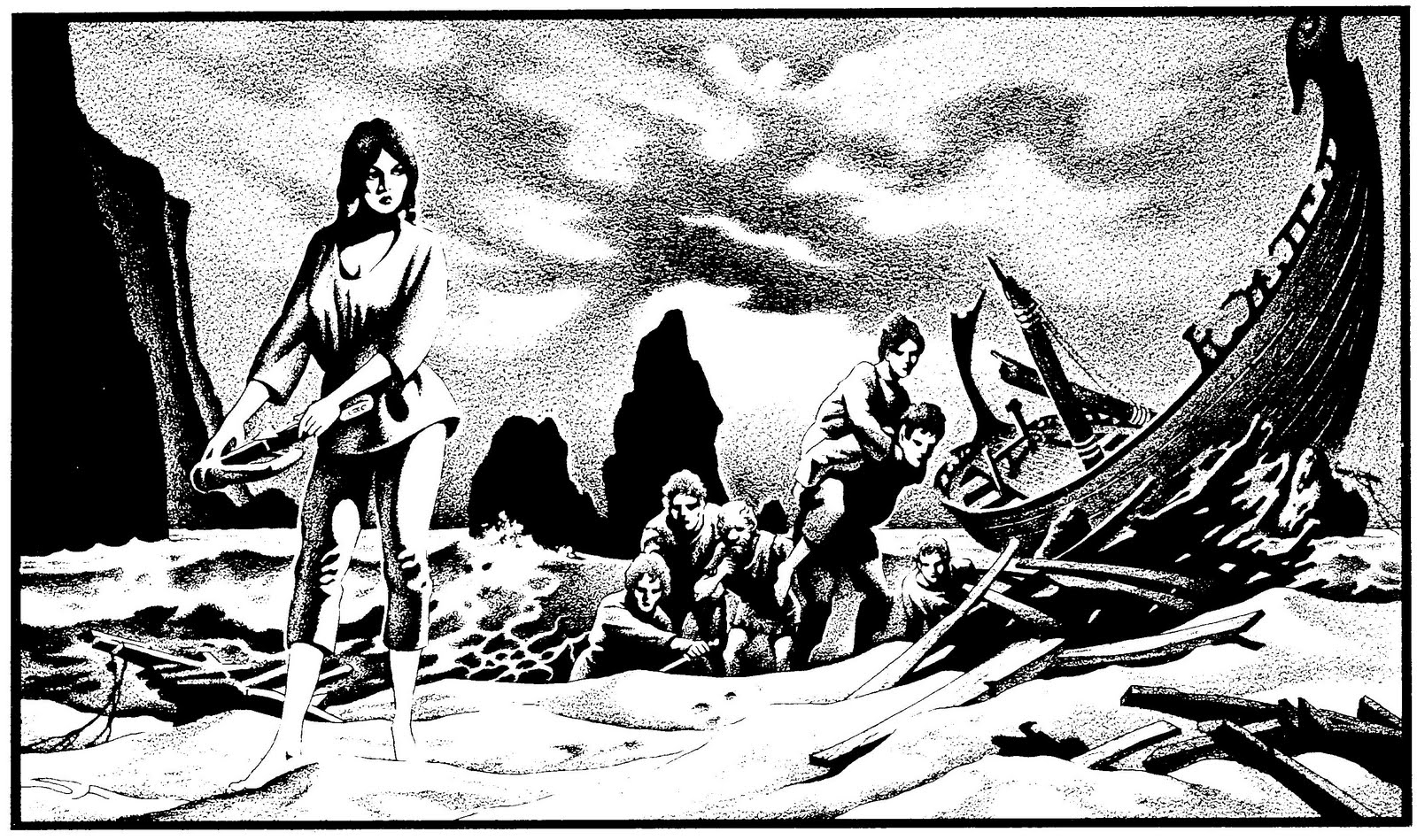
Possibly one of the most inappropriately named modules to be produced by TSR, N4 became something of an experiment. To the best of my knowledge, it was the only module ever released for 0 level characters – though the “Players Guide to the Dragonlance Setting- also had optioned rules for beginning play as a O level character, at least in some classes.

The basic premise is that the characters begin play as typical nobodies – 0 level fighters taken by slavers only to be stranded on a deserted island. Beginning at -500xp, the choices made by the characters during the game help determined what class that character eventually becomes at 1st level. The module includes convincing enough mechanics and encounters to justify development into just about every character class in any Old School setting. There is even a convincing “religious epiphany” moment to justify a character suddenly “finding god” and wishing to become a cleric.

Refreshingly, given that the characters begin with nothing more than the clothes on their back (or, rather, loins. They are slaves remember) the module tends to reward players that either avoid combat altogether or else cunningly take advantage of the environment to even the odds. By the time the characters reach a point in the adventure where they positively have to fight, they should have advanced to first level and scavenged enough weapons and armour to have a reasonable chance of surviving.

Ultimately, of course, the goal is to abandon the island and return to civilisation. The module includes brief notes on an island archipelago (one which contains the N-4 Island) as a setting for further adventures. Successful exploration of the nearby islands is facilitated by the ultimate treasure to found in the module – a boat.

For me, one of the best features of the module is that is allows new players to work out what type of character they would like to play, through play. Thus a character who decides he really would prefer to be a cleric rather than a fighter has a convincing means to change from one to the other mid-scenario without having to roll up a new character. Another plus is the very setting itself. It's an island, you can place it easily in just about any campaign setting. As an introductory, basic level adventure, it also provides a convincing reason for a motley mix of character races and classes to adventure together -they are escaping from a life of slavery together. Such shared experiences might very well create strong bonds within and between a group of people that might otherwise hate and despise one another. After all, it's hard to actively dislike someone who has helped save your life.

Like any commercial product, the module has it's flaws. It can be a rail-road at times, but with new players unused to gaming this can be a useful thing in and of itself. The module focuses on only one way off the island, yet it hints at two others, both of which would be much, much more difficult for the party to survive. Finally, there is a certain encounter in a temple which I have alluded to earlier. Yes it makes sense given the circumstances, but veteran players might role their eyes at the interest of such a being in a low level party. Come to think of it, there are two possible encounters in the temple that might have veteran players roll their eyes. The second because of a potential “Dick-DM/Ass-Hat” TPK kill moment. An encounter where the creature in question is deadly enough, thank you, without playing out the encounter exactly as written, however sensible the tactics used by the foe.

One of the primary areas of concern for me with regard to module selection is the ease with which a module can be converted to Hyboria. Happily, N-4 cn be adapted with a minimum of effort. The island setting makes it especially easy to incorporate into the Barrachan Isles Sandbox. The slavers are a classic Hyborian foe -and can lead on the Slaves Lords series of modules at a later date. Finally, the main antagonists of the module consist of warring bands of orcs and goblins. Obviously, for those who know Hyboria, this isn't exactly an appropriate choice of foe. Easy enough, however to replace the goblins with Picts and swap out the orcs for a band of Pirates. Success. Module adapted in under thirty seconds.

Treasure Hunt is an undiscovered, unforgotten gem of a module lost amid the sheer cornucopia of other, equally good entry level modules produced by TSR. Yet it's unique features should help it stand out from the crowd. This is why I'm especially happy for the opportunity to use it as the opening module of my new Hyborian campaign. A cracking module which, despite it's flaws, I love to run again and again.

Tuesday, 9 November 2010

Digging the Hyborian Sandbox Part I: Module Selection

One of the most exciting (and thrilling) aspects of Sandbox creation is, to my mind at least, picking out what modules to place on the map. The great appeal of the Barrachan Isles as a specific Hyborian setting is, frankly, the sheer joy of being to peruse some of the more “out of the way” module settings that otherwise rarely make an appearance in my sandbox. Specifically, I'm thinking of such classic jungle and desert modules as Isle of the Ape, Isle of Dread, The Hidden Shrine of Tamochen and Drums on Fire Mountain. I just don't get to use them in my more medieval campaign settings, purely because the location is such a major feature of these modules that to transplant them away from the natural home is, to me, simply an aberration. A jarring waste, if you like, of a good module.

Having been unable to find a “canon” map of the Isles, I'm also really excited about the opportunity to shape the Isles in my own vision. In effect, I have free reign to create my own maps of the Island chain (assuming I include all the canon locations that do exist, for the benefit of my puritan “Conanites”) enabling me to enjoy the entire sandbox creation process from start to finish. Step one in this creation process has (for me at least) always been module selection. After all, I don't know what location and terrain features I'm going to steal from published modules (and the geographical relationship between them as outlined in a given module), how the hell can I go about creating a decent map? I can't anyway, not without a half-dozen edits and even an outright re-draw or two.

So here we are at stage 1 of sandbox creation. I have a number (a very large number) of modules short-listed for consideration. Fortunately the Isle's are a fairly large geographical setting, even if most of the main map is going to be water and many urban scenarios will fit comfortably into the city Tortage. Happily, this means I won't be savaging the list too much with cuts. More happily, it gives me a good solid source of semi-regular blog posts while I go through each module, weighing up the pros-and-cons, deciding whether or not it has a place on the Barrachan Isles. The presence such principle elements as suitable sword & sorcery flavour and ease of conversion to a Hyborian setting (and the Isle's in particular) will be the primary factors in determining whether a given module receives a yea or nay.

Good times.

Here's a link to the working short-list, in no particular order. Numbers in brackets are the suggested level range. If anyone has any comments or suggestions for additions or subtractions to the list they would be most welcome.

Hyborian Module Short List

Here are the modules under consideration for inclusion in the Barrachan Isles Hyborian Age sandbox campaign.

  • N4- Treasure Hunt (1st level)

  • J1- The Jade Hare (levels 1-2)

  • Idol of the Orcs

  • Dark Raiders of Misty Ridge

  • The Sarcophagus Legion (2-4)

  • A1-4 Scourge of the Slave Lords (7-11).

  • WG05 Isle of the Ape (12+)

  • X1 Isle of Dread (3-7)

  • X6 Quagmire (4-7)

  • X8 Drums on Fire Mountain (5-8)

  • X9 The Savage Coast (4-10)

  • X12 Skardas Mirror (5-8)

  • C-1 The Hidden Shrine of Tamochen (5-7)

  • C-3 The Lost Island of Castanamir (1-4)

  • I-1 Dwellers of the Forbidden City (4-7)

  • I-2 Tomb of the Lizard King (5-7)

  • I-7 Baltron's Beacon (4-8)

  • I-8 The Ravager of Time (8-10)

  • I-9 Day of Al'Ak'Bar (4-8)

  • I-11 Needle (8-10)

  • I-12 Egg of the Pehonix (5-9)

  • N1 Against the Cult of the Reptile God (1-3)

  • R4 Docs Island (6-10)

  • R2 The Investigation of Hydell (1-3)

  • S4 Lost Caverns of Tjocanth. (6-10)

  • UK1 Beyond the Crystal Cave (4-7)

  • UK4 When a Star Falls (3-5)

  • UK5 Eye of the Serpent ()

  • UK6 All that Glitters (3-5)

  • UK7 Dark Clouds Gather (7-9)

  • U1-3 Saltmarsh series

  • B1 In Search of the Unknown (1-2)

  • B3 Palace of the Silver Princess (2-4)

  • B4 The Lost City (1-3)

  • B5 Horror on the Hill ()

  • B6 The Veiled Society (1-3)

  • B7 Journey to the Rock (1-3)

  • B9 Castle Caldwell and Beyond (1-3)

  • B10 Nights Dark Terrors (1-30)

  • .CM6 Where Chaos Reigns (17-19)

  • GA2 Swamplight (7-9)

  • The Lost Shrine of Bundashtur (8-10)

  • CM1 Test of the Warlords (15+)

Finally, for the Acheronian Ruins (the sand-box megadungeon) I'm once again considering StoneHell Dungeon, Castle of the Mad Archmage and Ruins of Greyhawk.

Sunday, 7 November 2010

New Side Project: OSRIC in The Hyborian Age

Having spent the last few days playing Age of Conan online, I'm well and truly in a "Conan" mood. So as a side project, I'll be working on a sandbox style campaign for Conan as well. Or rather, a series of sandboxes- why restrict the players to just one small part of a wonderful setting?

I've always wanted to use the N4 Treasure Hunt module, in which the characters are flung together by a shipwreck and have to escape a haunted island before a great cataclysm befalls it. The adventure has such a great sword and sorcery feel to it (including an encounter with a "Petty God") that it almost screams "Conan!"

So, I'll imitate the Age of Conan game by starting the campaign in the jungles of the Barrachan Isles. The great thing about this is it means I can replace the warring humanoids in the various island modules with, say, Pirates and Picts. It also gives me leave to strand the characters in a "Pirate City" (Tortage) and allows me to make good use of the many island based adventures released for early editions of D&D and AD&D over the years. Isle of Dread anyone? Isle of the Ape? Lost Island of Castamere?

I still want to develop Harn as my main "go-to" campaign sand-box. But I think that I'll introduce my players to OSRIC prior to the Harn campaign by playing through Treasure Hunt, which is, frankly, an excellent module and one of my very favorites.